
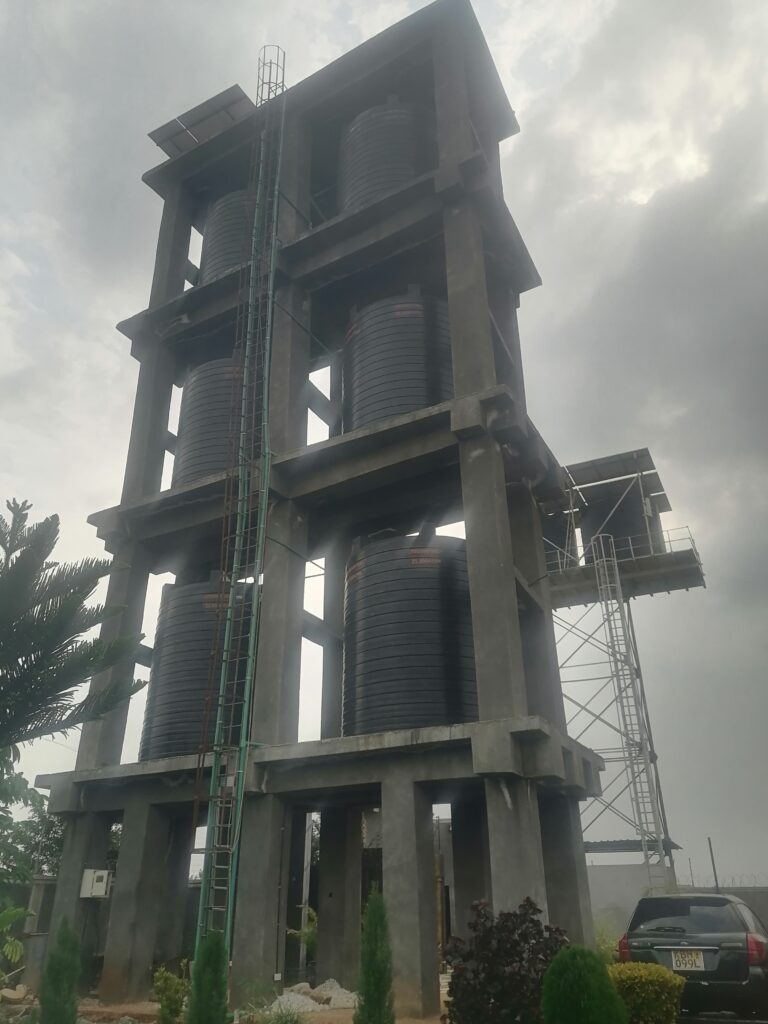
Erecting a steel water tower means lifting tonnes of steel and a large tank to a height, often on a remote site with few resources. The work involves heavy lifting, precise bolting and work at height, followed by filling the tank with a very heavy load. Done well, it is routine. Done badly, it can injure workers and damage the structure. This article explains the main erection methods, the correct sequence for a tower with tank and solar equipment, and the safety procedures that protect people and the structure.
Before Erection Begins
- Approved drawings and erection method statement, including member weights and sequence.
- Completed foundations with confirmed concrete strength. Towers should not be erected until concrete reaches the strength specified by the engineer, often at least 70 to 75 percent of the 28-day design value, and full strength before filling.
- Verified anchor bolt positions and levels.
- Risk assessment, rescue plan and permits.
- Trained team: supervisor, riggers, climbers and a first-aider.
- Inspected equipment: cranes, slings, shackles, gin poles, winches and fall protection gear.
- Weather plan, with limits for wind and lightning.
- Site access and storage, including a firm, level laydown area.
Common Erection Methods
1. Crane erection
A mobile crane lifts tower sections, the tank or both into place.
- Best for: towers up to 20 to 30 m, monopoles and sites with good access.
- Advantages: fast, fewer people at height, easy handling of heavy tank sections.
- Limits: needs access and firm ground for the crane; hire costs.
2. Ground assembly and lift
The tower is built in large sections or the tank is assembled on the ground and then lifted to the platform.
- Advantages: most bolting is done at ground level, which is safer and easier to inspect.
- Limits: crane capacity must handle the weight of the assembled tank (an empty 20 m³ pressed steel tank may weigh 3 to 5 tonnes).
3. Gin pole erection
A gin pole is a temporary lifting mast fixed to the tower. Members are hoisted by winch and bolted by climbers. The pole is “jumped” higher as the tower grows.
- Best for: remote sites where cranes cannot reach, such as rural borehole schemes.
- Advantages: independent of crane height; suited to hand assembly.
- Limits: slower, needs skilled riggers.
4. Tilt-up erection
The tower is assembled lying on the ground and raised with a winch or crane. It suits lighter, small tanks and solar mast structures.
5. Panel-by-panel tank assembly on the platform
For pressed steel tanks, panels are lifted individually to the top platform and bolted into rings, starting from the bottom ring and working upward, or in some systems from the top down using jacks.
Typical Erection Sequence for a Lattice Water Tower
- Set out and check anchor bolts.
- Level base plates with shims and nuts.
- Erect first tower section and brace temporarily.
- Add upper sections and bracing, checking plumb at each stage.
- Install ladder and platform framework.
- Tighten bolts progressively to the specified torque and mark them.
- Install tank support grid and level it.
- Assemble or lift the tank onto the grid, with the base evenly supported.
- Fit pipework: inlet, outlet, overflow, drain, vent and valves.
- Install level controls, earthing and lightning protection.
- Install solar frame and panels, and connect electrical equipment.
- Test, disinfect and commission.
Tank Filling and Testing
Filling a tank is a structural test of the tower and tank.
- Fill in stages, such as one third, two thirds and full, while inspecting for leaks and checking verticality and settlement.
- Hold full level for at least 24 hours and check seams, panels, fittings and foundations.
- Repair leaks and retest.
- Verify that the overflow works and discharges safely.
Disinfection and Commissioning
After testing, the tank must be cleaned and disinfected before use, following procedures such as AWWA C652 or the local water authority’s requirement. Typically chlorine solution is used at a specified concentration and contact time, then the tank is flushed until residual chlorine and water quality meet drinking-water standards. Commission control equipment, pumps and solar systems, and record the results.
Safety Procedures
Work at height. Falls are the main cause of death in tower work. Workers need full-body harnesses, twin-tail lanyards with energy absorbers and 100 percent tie-off from ground to platform. Use standards such as ANSI/ASSP Z359 and EN 361, 355, 353 and 795.
Rescue plan. Have trained rescuers and equipment on site before any climbing starts.
Lifting operations. Check crane load charts, slings and shackle certificates, use tag lines, keep people clear of loads and use a dedicated signaller.
Dropped objects. Tether tools, use tool bags and barricade the area below.
Weather limits. Stop climbing and lifting in strong wind or when lightning is near.
Confined spaces. Entering the tank for sealing, coating, cleaning or inspection is confined-space work, requiring a permit, ventilation, gas testing where needed, an attendant outside and rescue arrangements.
Chemical safety. Disinfectants and coatings need proper storage, PPE and ventilation.
Electrical safety. Solar panels are live whenever light falls on them, so cover or isolate arrays before working on wiring, and isolate pumps.
Structural stability. Never leave partially bolted sections unbraced overnight or before storms, and do not load platforms beyond design.
Kenyan Legal Framework
The Occupational Safety and Health Act, 2007 and rules for building operations and works of engineering construction require safe systems of work, risk assessments, trained workers, protective equipment and reporting of accidents to the Directorate of Occupational Safety and Health Services. Contractors should hold National Construction Authority registration. Confirm current requirements with the authorities.
Common Causes of Accidents
- Working without fall protection.
- Overloaded gin poles or cranes.
- Incomplete bolting.
- Working in high wind or storms.
- Poor communication between ground and climbers.
- Entering tanks without ventilation or an attendant.
- Filling tanks before foundations have gained strength.
Conclusion
Water tower erection combines structural assembly, heavy lifting and careful testing. Choose the method that suits the site, follow a defined sequence, test with staged filling and always put safety first. A well-planned erection delivers a tower that is safe, watertight and ready for decades of service.
Key references: ANSI/ASSP Z359; EN 361, EN 355, EN 353-1, EN 795; AWWA C652; AWWA D100; Kenya OSH Act 2007.
