
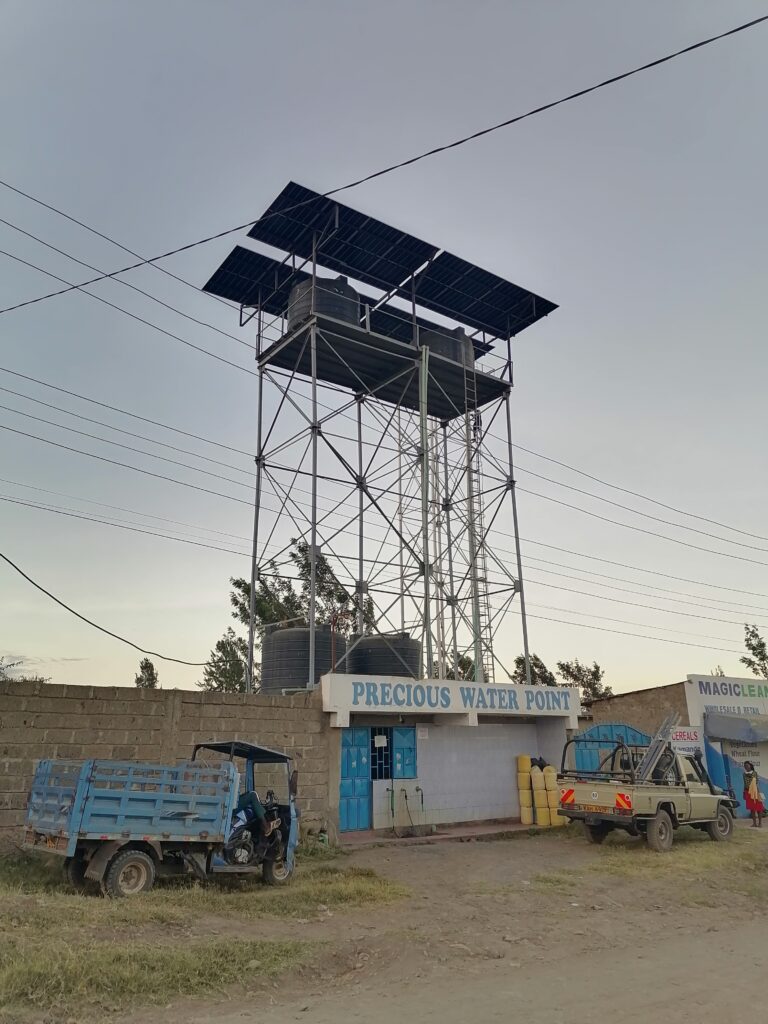
A water tower is only as good as the workshop that makes it. A mislocated hole, a poor weld or a thin coating may not show up on the day of handover, yet each one can cause leaks, corrosion or structural trouble years later. Because a water tower holds tonnes of water above people’s heads, fabrication quality is a safety issue as well as a durability issue. This article follows a steel water tower through the workshop and explains the checks that protect structure and water quality.
Step 1: Engineering and Shop Drawings
Fabrication begins with approved design drawings for the tower, platform, tank and accessories. Detailers prepare shop drawings with a mark number for every member and panel, along with lengths, hole positions, bolt sizes, weld details and coating requirements. Tank panels are drawn with their sequence and sealing details. The engineer should review shop drawings against the design model before production starts, because one detailing error repeated across hundreds of parts is costly.
Step 2: Material Procurement and Verification
- Structural steel (S275, S355 or equivalent) is purchased with mill certificates showing chemical composition and mechanical properties linked to heat numbers.
- Tank plate and panels must match the specified grade, thickness and coating.
- Bolts, nuts and washers are checked for grade markings and certificates.
- Sealants, gaskets and linings must be approved for contact with drinking water.
- Welding consumables are matched to the steel and stored dry.
Checks include comparing certificates with the specification, measuring thickness, inspecting surfaces and retaining heat numbers for traceability. Reject unmarked or mixed-grade steel before it enters production.
Step 3: Cutting, Punching and Drilling
Angles, tubes and plates are cut by saw, shear, plasma or laser. Holes are drilled or punched. For thick members drilling is preferred, because punching can create micro-cracks. CNC machines give high accuracy. Typical tolerances are hole diameter equal to bolt diameter plus 1.5 to 2 mm, hole spacing within about ±1 mm, and length within a few millimetres. First-piece checks confirm the machine setting before full production.
Step 4: Forming and Welding
For monopole shafts and welded tanks, plates are rolled and welded. For lattice towers, welding is limited to base plates, gussets and platform brackets. Welding should follow written procedures (WPS) by qualified welders under standards such as AWS D1.1, ISO 3834, EN 1090 or AWWA D100. Key controls include clean joints, correct preheat, dry electrodes, proper sequencing to limit distortion and visual inspection of every weld.
Step 5: Non-Destructive Testing
- Visual testing of all welds.
- Magnetic particle or dye penetrant testing for surface cracks at critical welds, such as base plates and platform supports.
- Ultrasonic or radiographic testing for shell and bottom welds of welded tanks, to a sampling rate set by the tank standard.
- Vacuum box testing of floor and roof seams.
- Leak testing by air pressure and soap solution or by filling with water.
Defects are repaired and retested, and the records are retained.
Step 6: Pressed Steel Panel Production
Pressed steel tank panels are manufactured by pressing flat sheets into profiled panels with flanges and holes. Quality checks include:
- Thickness measurement.
- Flange flatness and hole alignment.
- Surface condition before galvanizing or coating.
- Sealant groove geometry.
Panels are marked so that the right panel goes in the right position, because thicker panels are used lower in the tank where pressure is higher.
Step 7: Trial Assembly
For critical or complex towers, workshop trial assembly checks that tower sections fit together, base plates align with the anchor bolt template, platform beams carry the tank grid correctly and ladders line up. For pressed tank panels, a trial assembly of the first ring checks hole alignment and sealing details. Finding a fit-up problem in the workshop costs hours, but finding it on site 15 m in the air costs days.
Step 8: Surface Preparation, Galvanizing and Coating
After fabrication, members go to the galvanizing plant, where vent and drain holes are checked before dipping. QC checks coating thickness and appearance as described in the article on galvanizing. For tank interiors with epoxy linings, surfaces are blast-cleaned to the specified standard (commonly Sa 2.5), dust and moisture are controlled and coating is applied in specified coats and thickness. Holiday (pinhole) testing checks the lining for defects, and the cure is confirmed before shipment.
Step 9: Marking, Packing and Dispatch
Each member and panel is marked, packed by tower section or tank ring, and listed on a packing schedule. Bolts, nuts, gaskets, sealants and accessories are counted and packed separately. Galvanized steel is stacked with air gaps to prevent white rust, and coated panels are protected from damage during transport. A final check against the packing list avoids delays on site.
The Quality Management System
A reliable fabricator works under a documented system such as ISO 9001, with additional structural controls such as EN 1090-2 (execution class EXC2 or EXC3 for water towers). The project quality plan should include:
- Inspection and test plan (ITP): a table of activities, standards, methods, responsible people and hold points.
- Document control of drawings and revisions.
- Calibration of gauges and test equipment.
- Non-conformance reports and corrective actions.
- Records dossier with certificates, test results and inspection reports.
Third-Party Inspection
For municipal and high-value projects, an independent inspector may witness key stages: material receipt, welding, NDT, galvanizing, coating and dispatch. The additional cost is small compared with the cost of a defective tank.
Common Defects and Their Consequences
| Defect | Consequence |
|---|---|
| Wrong steel grade | Reduced capacity |
| Misplaced holes | Poor fit, field reaming weakens joints |
| Weld cracks or porosity | Leaks, fatigue |
| Thin galvanizing | Early rust |
| Damaged interior lining | Corrosion and contamination |
| Unapproved sealant | Taste and odour problems, health risk |
| Mislabelled parts | Erection delays |
Practical Tips for Owners
- Choose fabricators with proven water storage experience.
- Visit the workshop and review certificates and past projects.
- Require an agreed ITP and hold points.
- Confirm that all materials contacting water have potable water approval.
- Keep QC records, which are valuable for later audits and modifications.
Conclusion
Fabrication quality determines safety, durability and water quality. Verified materials, accurate cutting and drilling, qualified welding, leak testing, trial assembly and careful coating inspection together deliver a tower that fits on the first attempt and serves for decades. Set out expectations and a quality plan before production begins.
Key references: EN 1090-2; AWS D1.1; ISO 3834; ISO 9001; AWWA D100; AWWA D102; AWWA D103; ISO 1461; NSF/ANSI 61.
