
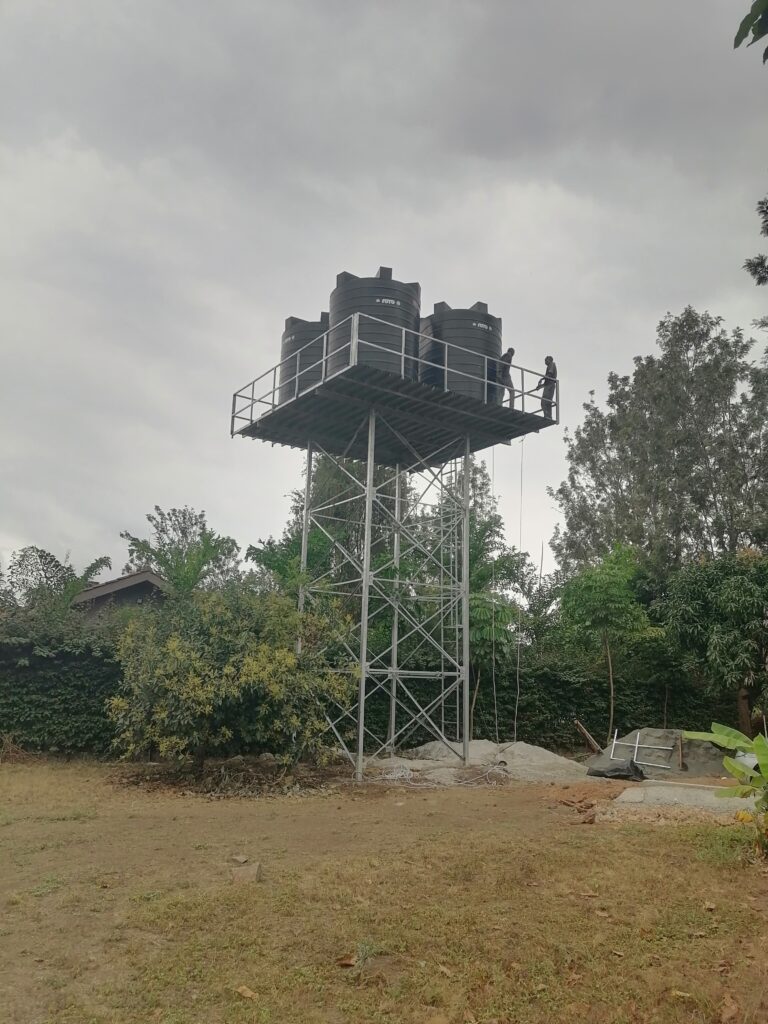
Clients often ask how much a water tower costs per metre of height. A better question is how much it costs per cubic metre of stored water at a required height, because a tall tower holding a small tank and a short tower holding a large tank are very different projects. This article explains what drives the price of a steel water tower, how the cost splits between tower, tank and foundation, and how to compare quotations fairly. Prices are not quoted here because steel, zinc, exchange rates and freight change often; the focus is on understanding the drivers.
Why a Single Price per Metre Misleads
The cost of the tower depends on the load it carries as much as its height. A 12 m tower under a 10 m³ tank needs light legs and small footings. A 12 m tower under a 100 m³ tank has ten times the water weight, far heavier legs and much larger foundations. Even at the same height, the cost can differ several times. Height does matter, however: overturning moment from wind rises quickly with height, and so do steel weight and foundation size.
Useful measures include cost per cubic metre of storage at a stated height, cost per tonne of fabricated and galvanized steel, and total installed cost.
Main Cost Drivers
1. Storage volume. Larger tanks cost more for the tank itself, and they increase water weight on the tower and foundation. Water weighs about one tonne per cubic metre.
2. Tower height. Required height depends on delivery pressure and terrain. Taller towers need more steel, heavier bracing, larger foundations and longer ladders.
3. Support type. Lattice towers are generally cheapest for common sizes. Monopoles cost more per tonne because of rolling, welding and heavy transport. Composite or concrete shaft towers cost most but suit large municipal storage.
4. Tank type and material.
- Pressed steel galvanized tanks are the common economical option for rural and institutional schemes.
- Epoxy or glass-lined bolted tanks cost more but last longer and give better water quality.
- Welded steel tanks suit larger volumes.
- Stainless steel is the most expensive.
- Plastic tanks are cheap for small volumes but limited in size.
5. Wind and seismic design. Exposed sites, lake shores, escarpments and seismic zones require heavier members and connections.
6. Steel price and weight. Steel is typically the largest part of fabrication cost. Higher-strength steel reduces weight but costs more per tonne.
7. Fabrication complexity. Welding, rolling and NDT add cost, and so do special fittings.
8. Galvanizing and coatings. Zinc cost is charged per tonne, and a duplex or interior lining adds more. Better protection raises initial cost but cuts lifetime cost.
9. Foundations. Foundations commonly make up 15 to 30 percent of total installed cost, and more on poor soils. Black cotton clay, soft sediments, high water tables or shallow rock affect the solution.
10. Transport and logistics. Distance, road condition, vehicle size and import clearance all matter. Pressed panels and lattice parts pack compactly, while monopole sections and welded tanks need special transport.
11. Erection and access. Crane hire, gin pole crews, remote site logistics and accommodation add cost.
12. Piping, valves and control. Inlet, outlet, overflow and drain pipework, valves, float switches or sensors and flow meters can form a significant share.
13. Solar power equipment. Panels, frames, controller, cabling, protection and pump size depend on pump head and flow. Costs may be separate from the tower budget but should be included in the whole project.
14. Earthing and lightning protection. Often underbudgeted but essential.
15. Approvals and professional fees. Design, geotechnical investigation, environmental assessment, permits and supervision.
16. Contractor margins, risk and warranties. Very low bids may mean lower quality.
Illustrative Breakdown of Installed Cost
For a typical lattice tower with a pressed steel tank, the split might look like this (indicative only):
| Component | Approximate share |
|---|---|
| Tank (supply and assembly) | 25 to 35% |
| Tower steel and fabrication | 20 to 30% |
| Galvanizing and coatings | 4 to 8% |
| Foundations | 15 to 25% |
| Transport and erection | 8 to 15% |
| Pipework, valves and controls | 5 to 10% |
| Earthing, ladders and safety | 3 to 6% |
| Design, testing and approvals | 3 to 8% |
Solar equipment is additional and depends on the pumping requirement.
How to Compare Quotations Fairly
Make sure each bidder prices the same scope. Provide:
- Tank volume, type and lining requirement.
- Tower height and type.
- Design standards and wind and seismic basis.
- Soil conditions or a geotechnical report.
- Coating and galvanizing specification.
- Scope of pipework, valves and controls.
- Solar equipment scope and pump duty, if included.
- Transport, erection, testing and disinfection responsibilities.
- Warranty and maintenance terms.
- Required certificates and documentation.
Then compare total installed cost, design calculations and quality plans, not just headline numbers.
Ways to Reduce Cost Without Cutting Safety
- Optimise height. Use hydraulic modelling to avoid over-tall towers.
- Right-size storage. Base volume on realistic demand and supply reliability.
- Invest in soil data. A borehole is cheap compared with foundation overdesign or failure.
- Standardise designs for multiple sites.
- Choose suitable tank type for water chemistry, to avoid early replacement.
- Plan logistics and schedule work in dry months.
- Use local fabrication where quality is proven.
- Integrate solar early so the frame, foundation and cabling are designed together.
Hidden Costs
- Unexpected ground conditions.
- Rework of non-conforming steel.
- Leakage repairs from poor sealing.
- Re-lining or replacing a tank early.
- Foundation repairs from settlement or erosion.
- Delays from permits or land disputes.
Lifecycle Perspective
A well-built tower can serve 30 to 50 years. Cheap tanks that need replacement in 10 years, or towers with thin coatings that need repair in five, cost more in the long run. Consider inspection and cleaning costs, pump energy, coating renewal and downtime when comparing options.
Conclusion
Water tower cost is driven by volume, height, tank type, wind and seismic exposure, soils, logistics and quality. Look at cost per cubic metre at a defined height and compare complete scopes, not just price per metre. The lowest quote is rarely the lowest lifetime cost once safety, water quality and durability are considered.
Key references: AWWA D100; AWWA D103; EN 1993-4-2; EN 1993-3-1; ISO 1461.
