
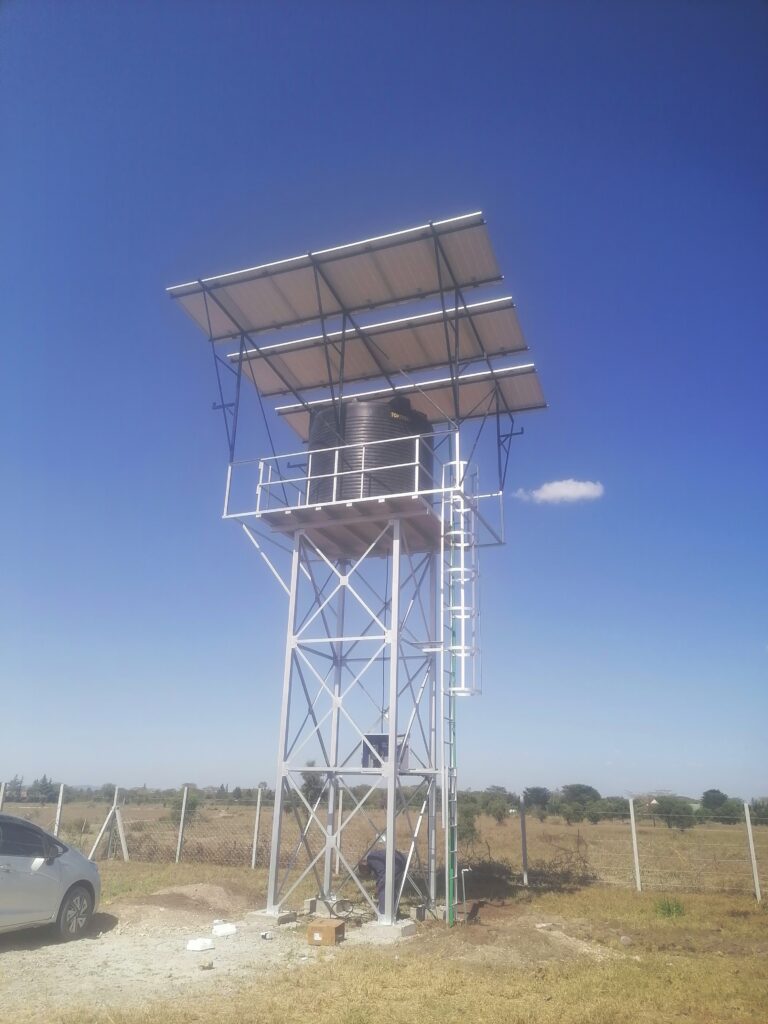
Water demand grows, tanks wear out and solar pumping becomes cheaper every year. Many owners now ask whether an existing steel water tower can carry a larger tank, a new lining or a solar array, or whether the whole structure must be replaced. Retrofitting is often cheaper and faster than building new, but it must be engineered. This article explains how to assess a tower for upgrades, which strengthening methods are used, and how to carry out tank and solar upgrades safely.
Why Retrofit?
- Increased demand: growing populations, schools, farms and industries.
- Tank deterioration: leaks, corroded panels, failed linings or poor water quality.
- Switch to solar pumping: reducing grid or diesel costs.
- Structural deterioration: corrosion or damaged members.
- Code updates: higher wind or seismic requirements.
- Height increase: improving network pressure by raising the tank.
- Better operation: adding sensors, telemetry or water treatment.
Step 1: Assess Before Anything Changes
Every retrofit begins with a structural audit. The engineer collects drawings, inspects the tower, builds a model and analyses it with the proposed new loads. Key questions are:
- Can the legs, bracing and connections carry the new tank weight, including water?
- Is the platform strong enough to support the new tank base?
- Can the foundation resist the increased compression and the empty-tank uplift?
- What happens to wind load if the tank is larger or panels are added?
- Is the tower still adequate in earthquake with the larger water mass?
The result is a utilisation ratio for each element. If any exceeds 100 percent, strengthening or a lighter option is needed.
Step 2: Reduce the Load First
- Choose a lighter tank, such as a modern pressed panel or plastic tank in place of an older, heavier one.
- Keep the same volume but replace a corroded tank, instead of increasing size.
- Reduce operating level, if the tower cannot carry a full tank.
- Lighten accessories: remove abandoned pipes, platforms and unused equipment.
- Reduce solar array wind area by using fewer, higher-efficiency panels.
Step 3: Strengthening the Tower
Legs
- Add reinforcing angles or plates to existing legs.
- Fill tubular legs with grout where design permits.
- Add secondary legs or intermediate supports to shorten effective length.
Bracing
- Add extra diagonals or horizontals.
- Replace under-sized or damaged members.
Platform and tank support
- Add beams or stiffeners under the tank to spread loads.
- Replace corroded platform steel.
- Ensure full-base support for the new tank.
Connections
- Replace corroded bolts with the correct grade and coating.
- Add gusset plates or extra bolts.
Monopole reinforcement
- Add external plates or ribs.
- Add stiffeners at the top flange and base.
Tower extension
Raising the tank increases wind moment strongly, so legs, bracing and foundation must be re-checked.
Welding on old galvanized or loaded members requires care, as heat damages coatings and may change material properties. Bolted solutions are generally preferred, with coatings restored after work.
Step 4: Foundation Upgrades
- Enlarge footings by casting additional concrete around existing pads.
- Add piles or micropiles to improve bearing and uplift capacity.
- Install ground or rock anchors to resist uplift.
- Add tie beams to reduce differential settlement.
- Improve drainage and protect the base from erosion by overflow water.
- Repair cracked concrete and protect exposed reinforcement and anchor bolts.
A geotechnical investigation is usually needed because upgrades depend on soil data that older towers rarely have.
Step 5: Tank Replacement and Relining
Replacement. Plan the sequence to minimise supply interruption. Consider a temporary storage tank or bypass. Remove the old tank safely, check the platform and steel condition, install the new tank on a level, full-base support and reconnect pipework.
Relining. Where the tank steel is sound, interior relining with a potable-water-approved coating can extend life. The surface must be blast-cleaned and the lining applied by trained applicators, with holiday testing and cure checks.
Water quality. After any tank work, clean and disinfect according to AWWA C652 or local requirements and flush before returning to service.
Seals and gaskets. Replace old sealants with approved materials, and tighten bolts to the manufacturer’s specification.
Step 6: Adding Solar Panels
Solar pumping is often the main driver for retrofit.
- Choose the location. A separate ground-mounted frame is often simplest. Mounting on the tower platform keeps panels safe from theft and shade but adds wind load and overturning moment.
- Check structural capacity. Include panel weight, frame weight and wind uplift in the analysis.
- Design the frame for wind pressure and suction on panels, with connections to the tower designed for uplift.
- Orientation and tilt. In Kenya, panels face roughly north or south depending on location relative to the equator, with a small tilt of about 10 to 15 degrees to allow rain to clean dust.
- Avoid shading from the tank, the tower or vegetation.
- Controller and pump. Match the array size, controller and pump to the borehole head and flow.
- Cabling and protection. Use UV-resistant cables in conduit, DC isolators, surge protection and proper earthing.
- Security. Use anti-theft fixings, fencing and, where practical, visibility from nearby buildings.
Step 7: Safe Implementation
- Prepare a method statement with sequence, so the tower is never left in an unstable condition.
- Use trained climbers and follow fall-protection rules.
- Treat the tank as a confined space when entering for lining or repairs.
- Isolate and cover solar panels while working on wiring.
- Use temporary water supply plans.
- Document modifications with updated drawings.
Step 8: Verification and Handover
After works, inspect the modified tower, confirm bolt tightness, coating restoration, verticality and tank level, and test the system with staged filling. Provide updated drawings, a maintenance manual and records.
Retrofit or Replace?
A retrofit is usually cheaper when the tower is sound and the shortfall is modest. Replace when:
- Corrosion is severe.
- Strengthening needs are extensive.
- The foundation cannot be upgraded.
- The required capacity is much larger than the existing design.
- Repairs would cost more than half of a new tower.
An engineer can compare cost, risk and expected life.
Common Mistakes
- Installing a bigger tank without a structural check.
- Ignoring empty-tank uplift on the foundation.
- Adding solar panels without checking wind loads.
- Leaving corroded bolts and base plates untouched.
- Using non-approved linings or sealants.
- Failing to update drawings.
Conclusion
Retrofitting extends the life of water towers and adapts them to new needs. Start with an audit, reduce load where possible, strengthen only what is needed, check the foundation, integrate solar carefully and protect water quality throughout. Done properly, a retrofit delivers more capacity and cleaner energy at a fraction of the cost of a new tower.
Key references: AWWA D100; AWWA D102; AWWA C652; AWWA M42; EN 1993-3-1; EN 1993-4-2; EN 1991-1-4.
