
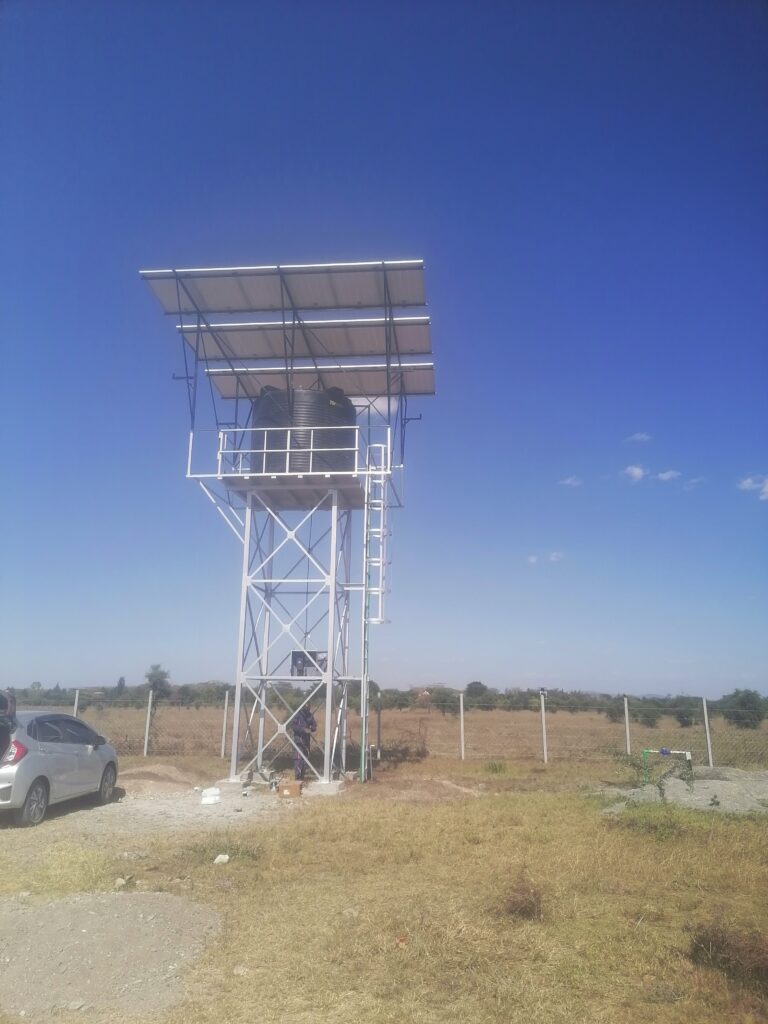
A steel water tower is often the tallest object for kilometres around, especially in rural areas, and Kenya has some of the highest lightning densities in the world around Lake Victoria, the Western highlands and parts of the Rift Valley. Add a solar array, a pump controller, level sensors and a borehole with a metallic casing, and the site has plenty of ways to be damaged. Lightning can destroy electronics, injure people at the base and damage tank linings. This article explains how lightning affects water towers and how to protect them.
How Lightning Affects a Water Tower Site
- Direct strike: current enters at the top of the tower, solar frame or tank roof and flows down to earth.
- Ground potential rise: current spreading into the soil raises voltage around the base, creating step and touch voltage hazards.
- Induced surges: the strong electromagnetic field induces voltage in solar cables, pump cables, signal lines and metallic pipes.
- Conducted surges: current flows along cables and pipes from the strike point to the pump, controller and borehole.
- Side flash: current jumps between the tower and nearby metal items.
A steel tank and tower are good conductors, so if properly bonded they can carry current safely. The danger comes from poor connections, high earth resistance and unprotected electronics.
Standards Framework
The IEC 62305 series (EN 62305) covers lightning protection: general principles, risk management, protection against physical damage and protection of electrical and electronic systems. Part 2 gives a risk assessment method, which determines whether protection is needed and at what level. IEC 62305-3 covers protection of structures, and IEC 62305-4 covers electrical and electronic systems. For solar installations, IEC 62548 and IEC 60364-7-712 address photovoltaic systems, including earthing and surge protection. National electrical codes and utility rules may add requirements.
Components of Protection
1. Air termination
A rod or conductor at the highest point intercepts strikes. On a steel water tower, the tank roof and tower steel may themselves serve as part of the air termination system if steel thickness and continuity meet the standard, but a dedicated air terminal above roof fittings and vents is good practice. Solar panels should lie within the zone protected by the air terminals, which is determined by the rolling sphere or protection angle method.
2. Down conductors
Current needs a low-impedance path to ground.
- Lattice towers: multiple legs provide parallel paths, which share the current and give low inductance.
- Monopoles: the shaft acts as the conductor, with flange joints bonded.
- Tank and tower connection: bolted joints should have verified electrical continuity, and bonding jumpers may be added across painted or sealed joints.
If the tank is plastic or insulating, a dedicated conductor is required.
3. Earth termination system
This disperses current into the ground. Typical elements include:
- Ring electrode around the tower base, usually buried 0.5 to 1 m deep and at a distance from the footings.
- Radial electrodes extending outward.
- Vertical rods driven to reach moist, low-resistivity layers.
- Foundation earthing, using reinforcement in footings where permitted.
- Enhanced materials such as conductive backfill in rocky or dry soils.
A target resistance of 10 ohms or less is common for power and pump installations, with lower values preferred, but the shape and layout of the earth system matter more than a single resistance number under lightning conditions.
4. Equipotential bonding
All metal parts, such as the tower, tank, ladder, pipework, pump controller enclosure, solar frame, borehole casing and fence, should be bonded to a common earth system. This prevents dangerous voltage differences during a strike.
5. Surge protection devices (SPDs)
SPDs protect electronics from surges.
- DC SPDs on solar array cables at the array and at the controller.
- AC SPDs at the main distribution board, if there is grid power.
- Signal line SPDs on level sensor and communication cables.
- Pump cable protection, especially for submersible pump cables running down a borehole.
SPDs only work if their earth connection is short and low in inductance. Lead lengths should be kept as short as possible.
Special Considerations for Solar Equipment
- Panel frames should be bonded to earth with proper conductors.
- Keep cable loops small: route positive and negative DC cables together to reduce induced voltage.
- Separate lightning conductors from DC cables where possible.
- Place controllers and inverters in metal enclosures bonded to the earth.
- Do not rely on panel frames as lightning conductors unless designed for it.
Special Considerations for Water Systems
- Metallic pipes can carry current into buildings or the pump house, so bond them at entry points.
- Borehole casing and rising main may be conductive, so bond them to the earth system at the wellhead.
- Tank linings and coatings can be damaged by current passing through poor connections, causing local heating or arcing.
- Plastic pipes may isolate steel parts, so check continuity.
- Cathodic protection systems need special coordination with the lightning protection design.
Personnel Safety
- Keep people away from the tower during thunderstorms.
- Provide warning signs and, where possible, fencing to limit access.
- Control step and touch voltage near the base by a buried ring electrode and, if needed, gravel surfacing.
- Operators should not climb or enter tanks during thunderstorms.
Testing and Maintenance
Earthing degrades through corrosion, theft and dry soil.
- Earth resistance testing at installation, annually and after strikes.
- Continuity tests of bonding and joints.
- Visual inspection of air terminals, connections and SPDs.
- Replace stolen or corroded conductors quickly.
- Replace SPDs that show failure indication or have been through strikes.
- Keep records to spot trends.
Common Problems
- Unbonded tank, tower and pipework.
- Copper conductors stolen from the earth system.
- High resistance in dry rocky soil.
- No SPDs on solar cables or pump controller.
- Loose, corroded or painted joints in the down conductor path.
- Large cable loops that pick up induced surges.
Conclusion
Lightning protection for a water tower is a system: air terminals, a continuous down conductor path, a low-impedance earth system, equipotential bonding and surge protection for the solar and pump equipment. Design from site-specific risk and soil resistivity, use quality connections, and test regularly. A modest investment protects people, pumps, controllers and the water supply itself.
Key references: IEC 62305-1 to -4; IEC 62548; IEC 60364-7-712; IEEE 80.
