
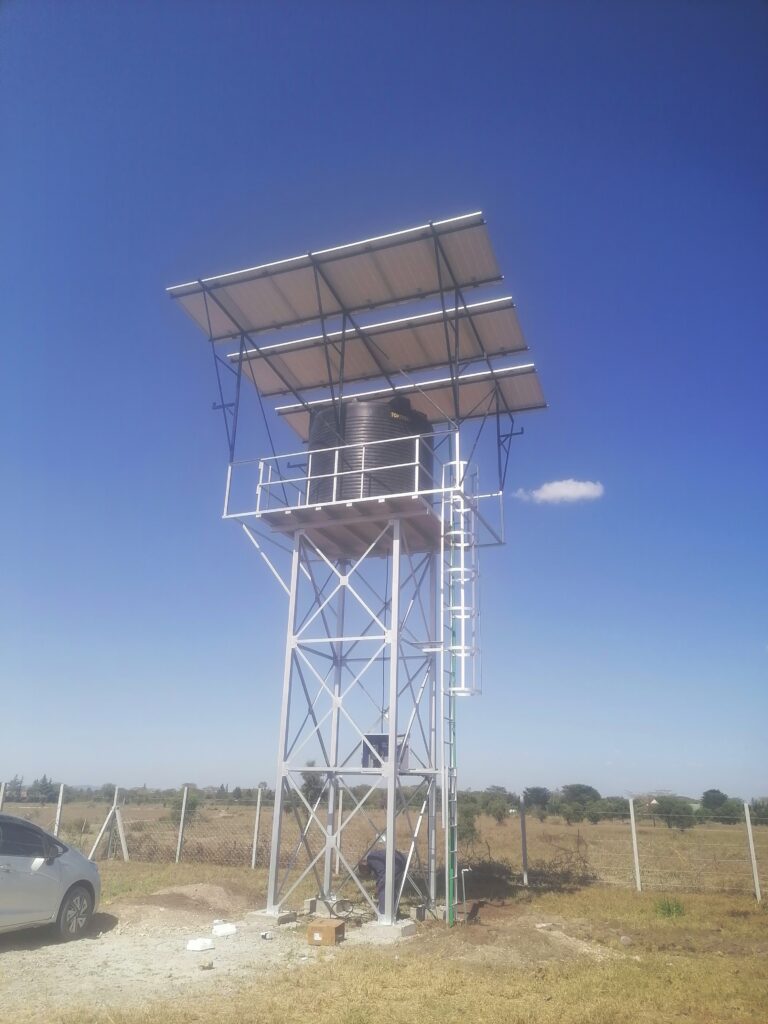
A steel water tower faces corrosion from two directions at once: the weather outside and the water inside. Rain, humidity, dust, coastal salt or industrial pollution attack the tower frame and tank exterior, while the stored water attacks the tank interior. Different parts need different protection. Hot-dip galvanizing is the standard solution for the tower frame and many tank panels, while the interior of the tank often needs a potable-water-approved lining. This article explains how galvanizing works, the standards that apply and how to check quality.
How Hot-Dip Galvanizing Works
Fabricated steel members are cleaned and then dipped in molten zinc at about 450°C. The zinc reacts with the steel to form a series of zinc-iron alloy layers topped with nearly pure zinc. The coating is metallurgically bonded to the steel, not just stuck on.
The usual steps are degreasing, pickling in acid, fluxing, drying, dipping, cooling and inspection.
Why Galvanizing Suits Water Tower Frames
- Barrier and sacrificial protection. Zinc blocks moisture, and if the coating is scratched, nearby zinc corrodes first.
- Full coverage. Edges, corners and hollow sections are coated.
- Long life. In most inland atmospheres, zinc loses about 1 to 2 micrometres per year, so an 85 µm coating can last 40 to 50 years or more.
- Low maintenance. No painting is needed in normal service.
- Toughness. It tolerates handling and transport better than paint.
- Easy erection. Galvanized members and bolts can be assembled on site without extra coating work, apart from touch-up.
Key Standards
- ISO 1461 covers hot-dip galvanized coatings on fabricated steel articles.
- ASTM A123 covers structural steel and plates, and ASTM A153 covers bolts, nuts and hardware.
- EN ISO 14713 gives guidance on corrosion protection design.
- ISO 9223 classifies atmospheric corrosivity.
- ISO 12944 covers paint systems.
- AWWA D102 covers coating systems for steel water-storage tanks.
- NSF/ANSI 61 (or an equivalent national approval) covers materials that contact drinking water.
For ISO 1461, minimum coating thicknesses are approximately:
| Steel thickness | Minimum local thickness | Minimum average thickness |
|---|---|---|
| Over 6 mm | 70 µm | 85 µm |
| Over 3 mm to 6 mm | 55 µm | 70 µm |
| 1.5 mm to 3 mm | 45 µm | 55 µm |
| Under 1.5 mm | 35 µm | 45 µm |
Pressed steel tank panels are thin, so their galvanizing is thinner than that of tower legs, which is one reason tank panels need more care and often an additional coating.
Protecting the Tank Interior
Galvanized steel in contact with water behaves differently from steel in air. Whether it is suitable depends on water chemistry.
- Soft, acidic or low-alkalinity water can dissolve zinc quickly.
- High chloride or sulphate water accelerates corrosion.
- Hard, alkaline water tends to form protective scales on zinc and perform well.
- Drinking water limits. Zinc dissolved from coatings can affect taste and, at high levels, acceptability. Choose coatings certified for potable water.
Common interior solutions include:
- Epoxy linings certified to NSF/ANSI 61 or a national equivalent, applied by trained applicators to a blast-cleaned surface.
- Glass-fused-to-steel panels, with factory-applied glass coating.
- Stainless steel panels.
- Food-grade polymer liners.
Interior coatings must be fully cured and flushed before disinfection. Never use industrial paints, bituminous coatings or coatings without drinking-water approval inside a potable tank.
Duplex Systems for the Exterior
A paint system over galvanizing gives a longer life than either alone, often 1.5 to 2.3 times the sum of the individual lives. This is recommended for coastal sites, industrial atmospheres and geothermal fields where hydrogen sulphide is present. Light exterior colours also reduce solar heating of the water. The galvanized surface needs light sweep blasting or a suitable primer before painting.
Design for Galvanizing
- Provide vent and drain holes in hollow sections so air escapes and zinc flows in and out. Sealed hollow members can explode in the zinc bath.
- Avoid tight overlapping surfaces that trap acid.
- Keep thickness consistent across assemblies to limit distortion.
- Limit member sizes to the kettle size, or use double dipping for long columns.
- Mark members with a method that survives galvanizing.
Quality Checks at the Galvanizer
- Visual inspection: continuous, reasonably smooth coating without blisters, flux, bare spots or sharp drips. Minor colour differences are cosmetic.
- Thickness measurement with a magnetic gauge at several points per item and lot.
- Adhesion test: the coating should not flake under a knife or hammer test.
- Dimensional checks: distortion, hole sizes, thread fit.
- Certificates: standard, lot identification, results and date.
Bolts, Nuts and Tank Panel Fasteners
Galvanized bolts and nuts are spun after dipping to remove excess zinc, and nuts are tapped oversize. Tank panel bolts must be compatible with the sealant and coating, and should not be dissimilar metals in contact, because galvanic corrosion occurs in wet joints. Do not hot-dip galvanize bolts above grade 10.9 without special procedures.
Repairing Damage
Damage during transport, drilling or welding should be repaired following ISO 1461 or ASTM A780 using zinc-rich paint, metal spraying or zinc solder. Clean, wire-brush and apply to the specified thickness. Never leave scratched or welded areas unprotected.
Environmental Classes
Most inland Kenyan sites fall in classes C2 to C3 and galvanizing alone performs well. Coastal sites at Mombasa, Kilifi and Lamu and industrial zones are C4 to C5, where duplex systems are recommended. Geothermal areas such as Olkaria and Menengai are very aggressive.
Common Problems
- Bare patches from poor cleaning.
- White rust from wet storage of freshly galvanized parts.
- Thin coatings on tank panels.
- Unapproved interior coatings.
- Zinc attack in soft water.
- Galvanic corrosion from mixed metals.
Conclusion
Galvanizing protects the tower frame for decades, but the tank interior needs coatings matched to water quality and approved for drinking water. Specify standards and thicknesses clearly, design members for galvanizing, inspect coatings at the galvanizer and repair damage promptly.
Key references: ISO 1461; ASTM A123; ASTM A153; ASTM A780; ISO 9223; ISO 12944; EN ISO 14713; AWWA D102; NSF/ANSI 61.
