
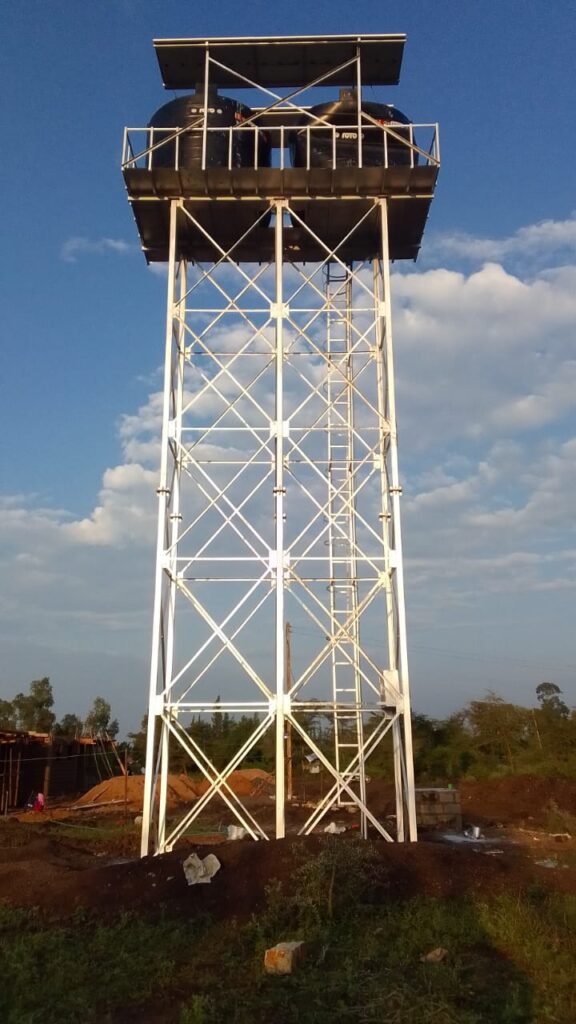
Erecting a steel tower combines heavy lifting, precision assembly and work at height, usually on a remote or constrained site. Done well, it is a controlled, repeatable process. Done badly, it is among the most dangerous activities in construction. This article explains the main erection methods, how to choose between them and the safety procedures that protect workers and structures.
Before Erection Begins
Safe erection starts well before the first lift. The following should be in place:
- Approved design and erection drawings, including assembly sequence and member weights.
- Completed and cured foundations, with concrete strength confirmed (commonly at least 70 to 75 percent of the 28-day strength before loading, subject to the engineer’s approval).
- Verified anchor bolt positions, level and projection.
- Method statement and risk assessment specific to the site.
- Competent personnel, including a supervisor, certified riggers, climbers and a trained rescue team.
- Inspected equipment, such as cranes, slings, shackles, gin poles, winches and fall-arrest systems.
- Permits and approvals, including work-at-height and lifting permits and landowner access.
- Weather plan, with limits for wind speed, lightning and visibility.
Common Erection Methods
1. Crane erection
A mobile or tower crane lifts sections or assembled panels into position. It is fast, particularly for monopoles and shorter lattice towers.
- Best for: monopoles, towers up to 40 to 60 m, sites with good access and firm ground.
- Advantages: speed, fewer climbers aloft, less manual hoisting.
- Limits: needs access for large vehicles, stable crane pad and sufficient reach and capacity. Crane cost is high.
2. Section-by-section assembly (stacking)
Ground-assembled sections are lifted and bolted atop each other. For lattice towers, three or four leg sections are assembled on the ground and lifted in place.
- Advantages: much of the work happens at ground level, where it is safer and easier to inspect.
- Limits: crane capacity governs the section weight.
3. Gin pole (jin pole) erection
A gin pole is a temporary lifting pole attached to the tower. Members are hoisted by winch to the working level and fixed by climbers. As the tower grows, the pole is jumped upward.
- Best for: remote sites, tall towers, and places where cranes cannot reach.
- Advantages: independent of crane height; suited to Kenya’s rural environments.
- Limits: slower, requires skilled riggers and careful pole stability checks.
4. Derrick erection
A derrick is a guyed boom mounted on the tower or a temporary mast. It handles heavier members than gin poles.
5. Tilt-up or tower-raising
The tower is assembled horizontally on the ground and rotated into place using hinges at the base and a winch or crane. Used for lighter masts and some guyed towers.
6. Helicopter erection
In extreme terrain, helicopters lift sections to mountain sites. Expensive, but sometimes the only practical option.
7. Climbing crane or self-climbing systems
For very tall towers, special cranes climb with the structure.
Choosing the Right Method
Consider tower height and weight, section sizes, site access, ground conditions, available equipment, timeline, cost and risk. A 30 m monopole on an urban plot will almost certainly be crane-erected. A 60 m lattice tower on a ridge accessible only by track may be built with a gin pole. The erection method should also be confirmed by the designer, because the partially built tower may experience different loads than the finished structure.
Key Erection Procedures
Setting out and base plate installation. Level the base plates with shims or levelling nuts and confirm alignment. Grout is placed after the structure is plumb.
Bolting. Install all bolts of correct grade, size and length, with washers as specified. Tighten progressively to the specified torque. Mark tightened bolts with paint to indicate completion. Never leave partial bolt groups on a lifted section.
Verticality. Check plumb at stages with theodolite or total station. Typical tolerance is a few centimetres per 100 m, or about 1 in 1,000 depending on specification.
Guy installation (guyed masts). Install guys at each level in sequence, tension according to the design table and re-check as the mast rises.
Temporary bracing. Where the structure is incomplete, temporary bracing or guys may be required to resist wind.
Final inspection and handover. Check all bolts, verticality, coatings, earthing, lighting and safety fittings before antennas are installed.
Safety Procedures
Work at height. Falls are the leading cause of death in tower work. Workers must use full-body harnesses, twin lanyards with energy absorbers, and remain 100 percent attached through the climb and while working. Standards such as ANSI/ASSP A10.48, ANSI/TIA-1019 and EN 361, 353 and 355 cover climbing and fall protection. Only trained and medically fit people climb.
Rescue plan. A suspended worker can suffer harness-related injury in minutes. A rescue plan, rescue equipment and at least two trained rescuers on site are essential, along with emergency contacts and a route to the nearest hospital.
Lifting operations. Check load charts, sling angles, rigging gear certificates and tag lines. Keep the exclusion zone clear and never walk under a suspended load. Use a designated signalman or radio communication.
Dropped objects. Tools are tethered, tool bags used, and a drop zone barricaded at the base. Hard hats are mandatory below.
Weather limits. Stop climbing and lifting at wind speeds specified in the plan, often around 10 to 12 m/s for crane lifts and lower for gin-pole work. Stop in the presence of lightning or thunderstorms within the defined distance. Rain makes steel slippery, and visibility affects signalling.
Electrical hazards. Identify overhead lines, buried cables and live equipment. Maintain approach distances and de-energise where required.
Radio frequency (RF) exposure. On sites with live antennas, RF safety assessments and shutdowns should be arranged before climbers work near transmitters.
Personal protective equipment (PPE). Helmet with chin strap, safety boots, gloves, high-visibility clothing, eye protection and harness.
Training and supervision. All workers should hold relevant certificates, attend toolbox talks, and know emergency procedures. A competent person should supervise at all times.
Legal Framework in Kenya
The Occupational Safety and Health Act, 2007, and the Building Operations and Works of Engineering Construction Rules require employers to provide safe systems of work, risk assessments, trained workers and reporting of accidents to the Directorate of Occupational Safety and Health Services (DOSHS). Contractors should register worksites and maintain records, and clients should vet contractors for safety performance.
Common Causes of Erection Accidents
- Skipping or removing fall protection to save time.
- Overloading gin poles or exceeding crane capacity.
- Incomplete bolting on lifted sections.
- Working in high wind or approaching storms.
- Poor communication between ground crew and climbers.
- Lack of rescue capability.
- Unstable ground under crane outriggers.
Conclusion
Tower erection is a controlled sequence of lifts, connections and checks. The right method depends on the tower and the site, but every method rests on the same pillars: sound planning, competent people, inspected equipment, correct bolting and uncompromising fall protection. Clients who prioritise safety and verify contractors’ procedures obtain better quality, fewer delays and, above all, safe projects.
Key references: ANSI/ASSP A10.48; ANSI/TIA-1019; EN 361, EN 353-1, EN 355; Kenya OSH Act 2007.
