
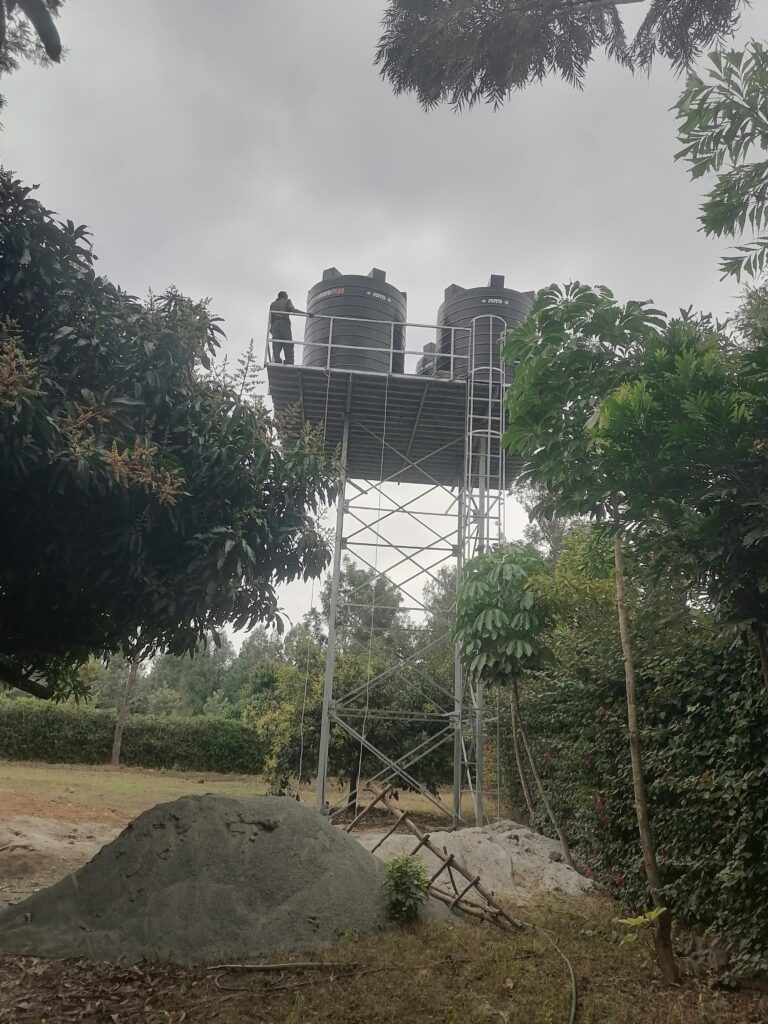
A water tower is one of the heaviest structures per square metre that a small foundation ever has to carry. A 50 m³ tank holds about 50 tonnes of water before the steel is counted, and all of that load concentrates on a few footings high above the ground. At the same time, when the tank is empty and a storm hits, the same foundations must resist uplift. This article explains the loads on a water tower foundation, the main foundation types and how to choose between them.
Loads on a Water Tower Foundation
Compression. Dead load of the tower and tank plus the weight of water, and the extra push on the leeward legs when wind overturns the structure.
Uplift. The tension in the windward legs when wind tries to tip the tower. It is worst when the tank is empty, because there is less weight to resist it.
Horizontal (shear) force. Wind and seismic forces that try to slide the foundation.
Overturning moment. Wind acts on the tank and frame well above ground, so the moment at the base is large.
Seismic and sloshing effects. In seismic zones, moving water adds horizontal force and moment.
Designers check both extremes: full tank for maximum compression and settlement, empty tank for minimum stabilising weight and maximum uplift.
Why Soil Investigation Comes First
The same tower can need a simple pad on rock or a pile group in soft clay. A geotechnical investigation provides soil layers, bearing capacity, groundwater level, rock depth and chemical aggressiveness. Boreholes with Standard Penetration Tests, laboratory tests and, where needed, rock coring are typical. For small community towers, one borehole near the tower position is the minimum. Without data, designers either overdesign at high cost or underdesign and risk tilting.
Water towers are especially sensitive to settlement because a tilted tower puts the tank off-level, stresses pipe connections and can lead to joint leakage.
Main Foundation Types
Pad (isolated) footings with chimneys
Each leg sits on its own reinforced concrete pad with a short column or chimney that holds the anchor bolts. The weight of the concrete and the soil above the pad resists uplift.
- Best for: firm soils, shallow rock and medium loads.
- Advantages: simple and economical.
- Limits: leg footings may settle differently if soils vary, so tie beams are often added.
Raft (mat) foundation
A single reinforced slab under the whole tower base.
- Best for: weak or variable soils, and heavy loads.
- Advantages: spreads load widely, reduces differential settlement, resists tilting.
- Limits: more concrete and steel, so higher cost.
Combined footings with tie beams
Pads connected by beams to act as a grid.
- Best for: moderate soils where differential settlement is a risk.
Piled foundations
Bored or driven piles carry load to stronger layers or develop friction in soft soil, with a pile cap under each leg or the whole tower.
- Best for: soft clays, loose sands, fill and high groundwater.
- Advantages: reach competent strata, good uplift capacity.
- Limits: higher cost and need for specialist equipment.
Drilled shaft (single pier) foundation
A deep reinforced concrete cylinder, used under monopole towers.
- Best for: monopole towers and sites with high overturning moments.
- Limits: needs drilling rigs and quality control.
Rock anchors and rock-socketed footings
Where bedrock is shallow, anchors grouted into rock resist uplift and small footings bear on rock.
- Best for: hills and volcanic terrain.
Ground Conditions Common in Kenya
Black cotton soil. These expansive clays swell when wet and shrink when dry, lifting and cracking shallow footings. Options include founding below the active zone, replacing the soil with compacted non-expansive fill, using piles, or using raft foundations designed for movement.
Soft lake or river sediments. Low bearing capacity and high compressibility call for piles or rafts.
Volcanic ash and tuff. Loose or variable, and can collapse when wet. Careful testing is needed.
Lateritic soils and weathered rock. Often good bearing but variable with depth.
High water table and flood zones. Buoyancy reduces uplift resistance, and flooding can erode the base. Raise foundations and provide drainage.
Saline or coastal soils. Use sulphate-resisting cement and extra concrete cover.
Special Considerations for Water Towers
Leakage and overflow. Water discharged from overflow or washout pipes can soften soil around the footing. Drain it well away from the foundation and use splash pads.
Settlement limits. Because the tank must stay level, allowable settlement and tilt are tight, typically a few millimetres of differential settlement across the tank.
Pipe connections. The riser pipe leaves the tower and connects to ground pipework. Flexible joints should be used so settlement does not break pipes.
Solar array loads. Panel frames may need separate foundations or tie into the tower foundation, with uplift checks.
Future extension. If the tank may be enlarged, design the foundation for the future load.
A Practical Selection Process
- Get the loads from the tower designer: compression, uplift, shear and moment, for full and empty tank.
- Review the soil report for bearing capacity, settlement, groundwater and aggressiveness.
- Shortlist options: pads on good soil, rafts or piles on weak soil, piers for monopoles, anchors on rock.
- Check constructability: access for concrete, drilling rigs, dewatering and weather.
- Compare cost and time, including excavation, steel, concrete and testing.
- Check settlement and tilt against limits.
- Specify durability: concrete grade, cover, cement type and anchor bolt protection.
Anchor Bolts and Base Details
Anchor bolts transfer tower leg forces to concrete. Use a steel template to fix positions before casting, since errors of a few millimetres prevent the base plate from fitting. Bolts should be galvanized with adequate embedment, nuts and washers. Grout beneath the base plates should be non-shrink and free from voids. Slope the top of the foundation so that water drains away and does not collect around the bolts.
Quality Control During Construction
- Check the founding soil against the design assumptions when the excavation is open.
- Use blinding concrete to protect the base.
- Verify reinforcement placement and cover.
- Test concrete slump and cube strength.
- Cure properly for at least seven days, longer in hot weather.
- Survey anchor bolt positions before the concrete sets.
- Allow the concrete to reach the specified strength, usually at least 70 to 75 percent of the design value, before erecting the tower and, for full loading, wait for the full strength.
Common Mistakes
- No geotechnical investigation.
- Ignoring empty-tank uplift.
- Placing footings in loose backfill.
- Poor drainage near overflow discharge.
- Misplaced anchor bolts.
- Underestimating settlement on soft clay.
Conclusion
Water tower foundations carry large, concentrated loads and must keep the tank level for decades. Combine site-specific soil data with careful structural design, choose the foundation type that suits the ground and loads, and supervise construction closely. Investing in good foundations is the surest way to protect the rest of the structure.
Key references: EN 1997-1 (Eurocode 7); AWWA D100; ACI 318 or EN 1992-1-1; BS 8004.
