
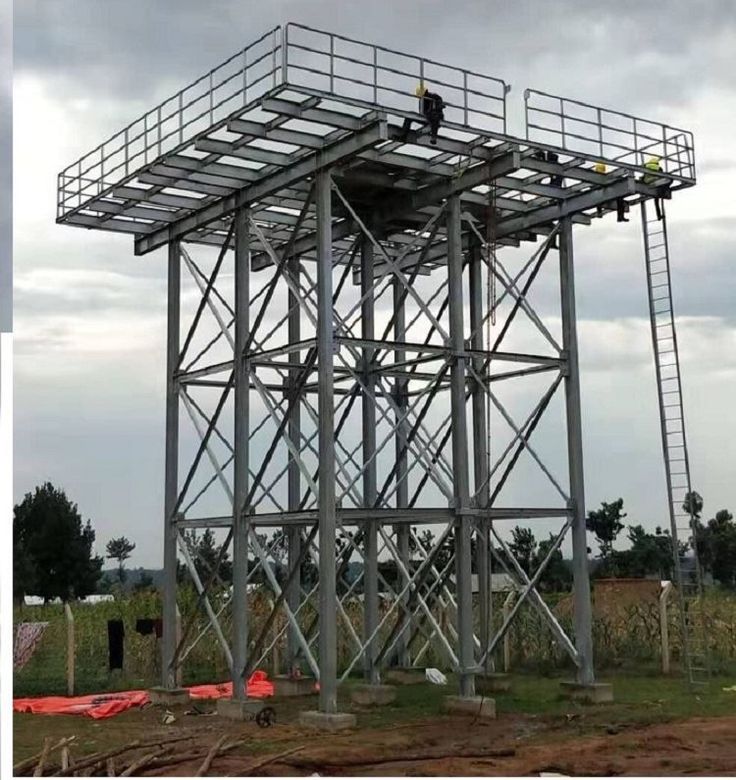
The tower steel gets the attention, but the foundation does the hardest job: it takes every force the structure collects and passes it safely into the ground. A well-chosen foundation is invisible and trouble-free for decades. A poorly chosen one leads to tilting, cracking, cost overruns and sometimes collapse. This article explains the main foundation types for steel towers and how to select the right one.
What Loads a Tower Foundation Must Resist
A foundation sees four main actions.
- Compression: the weight of the tower plus the push from wind-induced overturning on the leeward side.
- Uplift: the pull-out force on the windward side. For lattice towers, uplift is often the governing check.
- Shear (horizontal) force: wind and conductor forces that try to slide the foundation sideways.
- Overturning moment: the rotation caused by wind at height, which is especially important for monopoles and guyed mast bases.
Design codes require safety factors against bearing failure, uplift, sliding, overturning and excessive settlement or tilt. Towers carrying microwave dishes can tolerate very little rotation, so serviceability limits are often tighter than strength limits.
Why Geotechnical Data Comes First
No foundation type can be selected sensibly without knowing the ground. A geotechnical investigation provides soil layers, strength, groundwater level, rock depth, chemical aggressiveness and, in Kenya, the presence of expansive black cotton clay or collapsible soils. Boreholes with Standard Penetration Tests, cone penetration tests, laboratory classification and, where needed, rock coring give the design parameters. For small sites, one borehole may suffice; for large transmission lines, investigation at each tower or every few towers is typical.
Common Foundation Types
Pad and chimney (spread) footings
A reinforced concrete pad sits below ground with a vertical chimney or pier connecting it to the tower leg. The weight of the concrete and the soil above the pad resist uplift, while the pad area spreads compression into the ground.
- Best for: stiff soils and shallow rock where excavation is easy.
- Advantages: simple, low-cost, widely understood.
- Limits: large excavation, poor performance in soft or high-water-table ground.
Raft (mat) foundations
A single large slab supports all legs or the base plate. It spreads load across a wide area.
- Best for: weak soils with low bearing capacity, or sites where differential settlement between legs must be avoided.
- Advantages: good tilt control, shallow depth.
- Limits: large concrete volume, can be expensive.
Drilled shaft (bored pier or caisson)
A deep cylindrical shaft is drilled and filled with reinforced concrete. Resistance comes from side friction and end bearing.
- Best for: monopoles and heavily loaded towers; also useful for high overturning moments.
- Advantages: strong against overturning and uplift, small footprint.
- Limits: needs drilling rigs, quality control of concrete, difficult in running sand or high groundwater without casing.
Driven or bored piles
Steel, precast concrete or cast-in-place piles transfer load to deeper competent layers. Groups of piles under a cap may be used.
- Best for: soft clays, loose sands, fill and areas of very weak surface soil.
- Advantages: reach strong strata, good uplift capacity with friction.
- Limits: higher cost, mobilisation of equipment, vibration concerns in sensitive areas.
Rock anchors and rock-socketed foundations
Where bedrock is shallow, anchors grouted into drilled holes resist uplift, and small footings bear on rock.
- Best for: hills, escarpments, volcanic terrain and sites with outcrops.
- Advantages: smaller concrete volumes, high capacity.
- Limits: requires accurate rock quality assessment, specialised drilling and grouting.
Grillage and steel-frame foundations
Steel beams embedded in a granular base transfer load to the soil. These are used in some transmission line designs and temporary structures.
- Advantages: quick installation, easy transport.
- Limits: corrosion risk and lower uplift resistance unless carefully backfilled.
Guy anchors
For guyed masts, each guy needs an anchor block, plate anchor or rock anchor. They resist large inclined pulls and must be designed for both uplift and horizontal pullout.
Special Ground Conditions in Kenya
Black cotton soil. These expansive clays swell when wet and shrink when dry, lifting and cracking shallow foundations. Solutions include deeper foundations below the active zone, replacing the soil with compacted non-expansive fill, or piles with void-formers.
Volcanic ash and tuff. Rift Valley soils can be loose, crusted or highly variable. Test results should be checked carefully for collapse potential.
High water table or flood plains. Buoyancy reduces uplift resistance and soft soils reduce bearing capacity. Piles or raised pads are common solutions.
Lateritic soils and weathered rock. These often provide good bearing, but strength varies with depth. Test pits and boreholes help confirm.
Coastal and saline soils. Aggressive chlorides and sulphates call for sulphate-resisting cement, higher cover to reinforcement and corrosion-resistant anchor bolts.
A Practical Selection Process
- Collect loads. Obtain factored compression, uplift, shear and moment at the base from the tower designer.
- Review geotechnical data. Identify bearing layers, groundwater and constraints.
- Shortlist options. Match types to soil: pads for good soil, piles or rafts for soft soil, rock anchors for shallow rock.
- Check constructability. Consider access, equipment, concrete supply, dewatering and weather.
- Compare cost and time. Consider total cost including excavation, reinforcement, concrete, formwork and testing.
- Check serviceability. Verify settlement, tilt and rotation limits for antennas.
- Confirm durability. Specify concrete grade, cover, cement type and protective coatings for anchor bolts.
Anchor Bolts and Connection Details
The link between tower and foundation is critical. Anchor bolts must be accurately positioned using a steel template, because errors of even a few millimetres can prevent the tower base plate from fitting. Bolts should be galvanized, with sufficient embedment length and lock nuts. Grouting beneath base plates must be complete and free from voids.
Quality Control During Construction
Good design can be ruined by poor workmanship. Essential checks include verification of excavation depth and soil condition against the design assumptions, reinforcement placement and cover, concrete slump and cube strength, curing, and survey of anchor bolt positions before the concrete sets. For piles and shafts, integrity testing and load tests may be required.
Common Mistakes
- Designing from a desktop study with no boreholes.
- Ignoring groundwater when checking uplift.
- Using standard foundation drawings on soils that differ from the design basis.
- Failing to account for future load increases when new antennas are added.
- Poor concrete curing in hot weather, leading to cracking.
Conclusion
Foundation selection is a balance of loads, soil, construction practicality and cost. Pad footings, rafts, shafts, piles and rock anchors all have their place. The best results come from combining accurate geotechnical data with thoughtful structural design and careful site supervision. Investing in site investigation early nearly always saves money later.
Key references: ANSI/TIA-222-H; EN 1997-1 (Eurocode 7); ASCE 10; BS 8004.
