
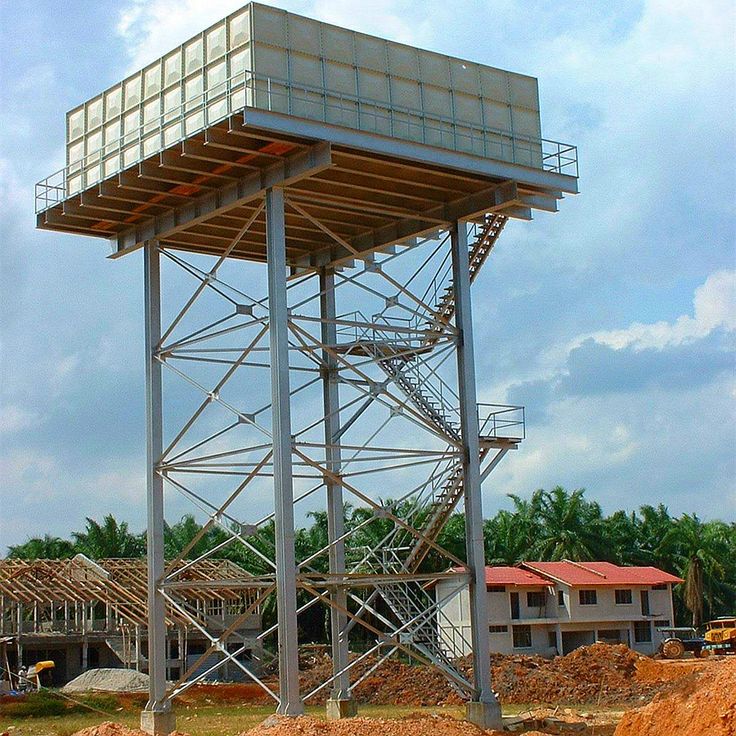
Choosing the right support structure is one of the first decisions in any elevated water storage project. The tower has to carry a very heavy tank, resist wind and earthquakes, fit the site and the budget, and sometimes look acceptable to neighbours. This article compares the three families of steel supports, lattice (braced-leg) towers, monopole (single-column) towers and guyed supports, and explains where each works best for water tanks and solar-powered pumping schemes.
Lattice (Braced-Leg) Towers: The Standard Choice
A lattice water tower has four, six or eight legs joined by horizontal struts and diagonal bracing, with a platform at the top that carries the tank. Members are steel angles, round bars or tubes.
Advantages
- Efficient use of steel. Loads travel as axial forces in slender members, so the structure is light for its capacity.
- Good capacity for heavy tanks. Multiple legs share the load and the tower resists overturning well.
- Easy transport and assembly. Members are small, can be carried on light trucks and bolted by a small crew, which suits remote sites.
- Simple foundations. Light pad footings under each leg are cheaper than one large pier.
- Easy modification. Platforms, ladders and solar frames can be added, and members replaced.
- Good ventilation and inspection access around the tank bottom.
Limitations
- Larger footprint, since legs splay outward at the base.
- More bolts and members to inspect and maintain.
- Visual impact in neighbourhoods, though many users see them as normal rural infrastructure.
- Climbing exposure, so anti-climb guards are important.
Best uses: community boreholes, schools, farms, small towns, institutions, and any project with tanks of 5 to 200 m³ at heights of 6 to 30 m.
Monopole (Single-Column) Towers: Neat and Compact
A monopole water tower uses a single tapered or cylindrical steel shaft that carries the tank on top. Some designs use the column itself as a riser pipe, but a separate pipe is normally preferred for inspection and repair.
Advantages
- Small footprint, useful on tight urban plots, school compounds and estates.
- Clean appearance, easier to accept in residential or commercial areas.
- Few external members, so less to climb, paint or inspect.
- Inside space. The hollow shaft can house pipes, a ladder, electrical cables or a pump control panel, protected from weather and theft.
- Quick erection, often by crane in a day once the foundation is ready.
Limitations
- More steel per metre at height, because bending moment is carried by the shaft wall rather than axial forces.
- Heavy sections that need cranes and wide transport routes.
- Large concentrated foundation, typically a drilled pier or big pad.
- Higher fabrication cost due to plate rolling, welding and NDT.
- Less flexible for modification.
Best uses: urban and peri-urban sites, institutions that value appearance, heights up to about 20 to 25 m, and tank volumes up to roughly 100 m³.
Guyed Supports: Rare for Tanks
A guyed support is a slender mast braced by steel cables. For water tanks it is rarely suitable, because a loaded tank puts very high vertical force on a slender mast and any guy failure could be catastrophic. Guy cables also need a large clear area and regular tension checks.
Where guys are used, it is typically for light tanks, such as small plastic tanks on a mast at a remote hilltop, or for stabilising a small solar array mast. Most engineers recommend lattice or monopole designs for storage towers.
Best uses: light, small structures in open land where cost is critical and failure consequences are low, such as a mast for solar panels and a tank of only a few cubic metres.
Other Options Worth Knowing
- Multi-column frames, with three or four vertical tubes and bracing, offer a tidy look and good stiffness.
- Ground-level tanks on hills, which avoid a tower altogether where topography provides head.
- Composite towers, where a concrete or masonry base supports a steel tank on top, used for larger municipal reservoirs.
Side-by-Side Comparison
| Factor | Lattice | Monopole | Guyed |
|---|---|---|---|
| Typical tank size | 5 to 200 m³ | 5 to 100 m³ | Under 5 m³ |
| Typical height | 6 to 30 m | 6 to 25 m | Light mast only |
| Footprint | Medium | Small | Large (guys) |
| Steel use | Efficient | Higher | Lowest |
| Appearance | Industrial | Neat | Slender |
| Transport | Easy | Heavy sections | Easy |
| Foundation | Several small pads | One large pier | Small pad plus anchors |
| Maintenance | Moderate | Low | High (cables) |
| Suitability for tanks | Excellent | Good | Poor |
How to Choose
Tank volume. The heavier the tank, the more attractive a multi-leg lattice becomes. Above about 100 m³, lattice or composite designs dominate.
Height required. Hydraulic head requirements set the minimum height. Monopoles become expensive as height grows.
Land available. Tight sites push towards monopoles, open sites suit lattice.
Appearance and planning. Residential areas, schools and hospitals often prefer the monopole look.
Soil conditions. Poor soils may favour lattice towers with spread footings or piles under each leg, while good rock suits a single pier.
Solar panel integration. A lattice tower can host a platform or frame for panels more easily. A monopole may need a separate frame next to it.
Access and logistics. Remote sites without crane access suit lattice towers that can be assembled by hand and gin pole.
Budget and lifecycle. Compare the total installed cost, including foundation, coating, erection and maintenance.
Common Mistakes
- Choosing a monopole for a tall, heavy tank without comparing cost.
- Using a guyed mast for a full-size storage tank.
- Ignoring wind on the tank, which acts high above ground and creates large overturning moments.
- Designing for the full tank only and forgetting the empty-tank uplift case.
- Skipping geotechnical investigation.
- Forgetting space for the solar array and its shading.
Conclusion
For most community, farm and institutional water supplies, a braced-leg lattice tower is the most economical and flexible choice. Monopoles earn their place on compact, visible sites, and guyed supports are best left to light, small structures. Match the support to the tank, the soil, the site and the budget, and have a structural engineer confirm the choice.
Key references: AWWA D100; EN 1993-3-1; EN 1993-4-2; EN 1991-1-4.
