
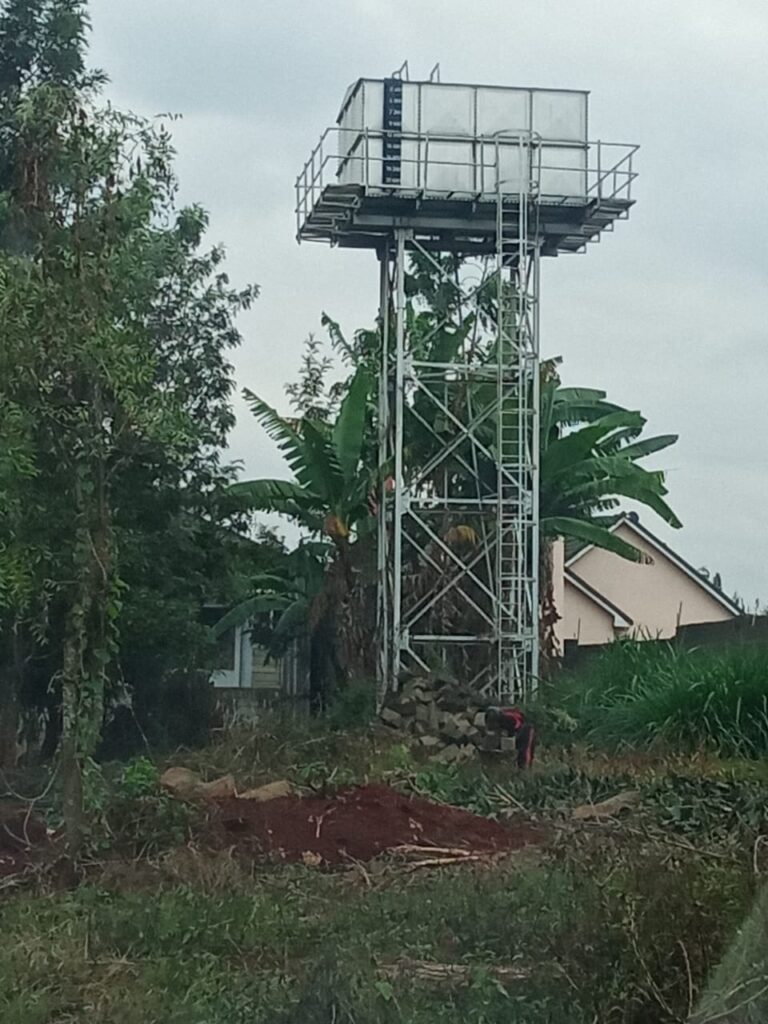
A steel tower should serve for 30 years or more with little maintenance. In most cases, that long life is made possible by one process: hot-dip galvanizing. By coating steel with a metallurgically bonded layer of zinc, galvanizing protects against rust both as a barrier and through sacrificial action. This article explains how the process works, which standards apply and how to check that the coating you paid for is the coating you received.
How Hot-Dip Galvanizing Works
Fabricated steel members are cleaned and then dipped in molten zinc at about 450°C. The zinc reacts with iron to form a series of zinc-iron alloy layers, topped by a layer of nearly pure zinc. The result is a tough coating that is chemically bonded to the steel rather than merely stuck onto it.
The typical process steps are:
- Degreasing to remove oil, grease and dirt.
- Pickling in dilute hydrochloric acid to remove mill scale and rust.
- Fluxing in a zinc ammonium chloride solution to prevent oxidation before dipping.
- Drying to avoid splashing in the zinc bath.
- Galvanizing by immersion in molten zinc until the steel reaches bath temperature.
- Withdrawal and cooling by air or water quench.
- Inspection and finishing to remove drips and check the coating.
Why Galvanizing Suits Towers
- Barrier protection: the dense zinc layer blocks moisture and oxygen.
- Cathodic protection: if the coating is scratched, surrounding zinc corrodes in preference to the exposed steel.
- Complete coverage: inside corners, edges and hollow sections are coated when dipped.
- Durability: in most inland atmospheres, zinc corrodes at roughly 1 to 2 micrometres per year, giving decades of protection from a coating of 85 micrometres.
- Low maintenance: no painting is required during normal service life.
- Toughness: the coating resists transport and erection damage better than paint.
Key Standards
ISO 1461 specifies requirements for hot-dip galvanized coatings on fabricated iron and steel articles. It sets minimum coating thickness by steel thickness, appearance requirements and test methods.
ASTM A123/A123M covers zinc coatings on iron and steel products, including structural shapes and plates, with grades by steel thickness.
ASTM A153/A153M covers hardware such as bolts, nuts and washers.
EN ISO 14713 gives guidance on the corrosivity of environments and the protective life of zinc coatings.
EN ISO 10684 applies to fasteners.
For ISO 1461, minimum average coating thicknesses are approximately:
| Steel thickness | Minimum local thickness | Minimum average thickness |
|---|---|---|
| Over 6 mm | 70 µm | 85 µm |
| Over 3 mm to 6 mm | 55 µm | 70 µm |
| 1.5 mm to 3 mm | 45 µm | 55 µm |
| Under 1.5 mm | 35 µm | 45 µm |
Most tower legs and bracing fall in the over-6 mm category and need at least 85 µm on average. Many project specifications for towers in coastal or industrial zones require more.
Design for Galvanizing
Good galvanizing begins at the design stage.
- Provide vent and drain holes in hollow sections and closed profiles so air can escape, zinc can flow in and out, and pressure does not build up. Without them, sections can explode in the bath, which is a serious safety hazard.
- Avoid overlapping surfaces with tight gaps, which trap acid and cause bleeding after galvanizing.
- Keep sections of similar thickness in an assembly to avoid distortion.
- Mark steel clearly so members can be traced after galvanizing without paint or stickers that interfere with the coating.
- Limit member length to fit available kettles, or use double dipping for long monopole sections.
Steel Chemistry and Coating Appearance
Silicon and phosphorus in steel strongly influence zinc growth. Steel with silicon above about 0.04 percent but below 0.14 percent, or above 0.25 percent, can produce thick, brittle, dull-grey coatings. These are usually still protective, but they may be more susceptible to mechanical damage. Controlling steel chemistry at procurement and agreeing acceptance criteria with the galvanizer reduces disputes.
Quality Checks at the Galvanizer
Visual inspection. Coatings should be continuous, reasonably smooth and free from blisters, flux deposits, uncoated areas, sharp spikes and heavy dross inclusions. Minor surface variations, such as slight roughness, colour differences and spangle patterns, are cosmetic and normally acceptable.
Thickness measurement. A magnetic or electromagnetic gauge is used to measure coating thickness at multiple points on each inspection lot. For ISO 1461, the mean of readings in each reference area must be at least the minimum average, and no individual reading in the lot should fall below the local minimum in a way that violates the standard.
Adhesion test. A knife or hammer test checks that the coating is firmly bonded and does not flake.
Mass per unit area. In disputed cases, a stripping test determines coating mass by weighing a sample before and after removing the zinc.
Dimensional checks. Distortion, hole size, thread fit and straightness are verified so the tower will assemble properly.
Certificates and traceability. The galvanizer should issue a certificate showing the standard, steel heat numbers or lot identification, coating results and date.
Bolts, Nuts and Threads
Fasteners are galvanized by dipping and spinning to remove excess zinc. Nuts are tapped oversize after galvanizing, so they fit on the coated bolt threads. Higher-strength bolts above grade 10.9 risk hydrogen embrittlement during pickling and should not be hot-dip galvanized without special procedures. Most tower bolts at grade 8.8 or equivalent are galvanized successfully, and lubricating the thread improves torque consistency.
Repairing Damaged Galvanizing
Damage occurs during transport, handling, drilling or welding on site. Small areas can be repaired in accordance with ISO 1461 or ASTM A780 using zinc-rich paint, zinc metal spraying or zinc solder sticks. The surface should be cleaned and wire-brushed, and the repair material should provide a thickness at least equal to the surrounding coating.
Environment and Service Life
ISO 9223 classifies atmospheric corrosivity from C1 (very low) to CX (extreme). Most inland Kenyan sites fall within C2 to C3, where hot-dip galvanizing at 85 µm can last 50 years or more. Coastal sites near Mombasa and Lamu and industrial areas may reach C4 or C5, where life is shorter, and duplex systems of galvanizing plus paint are often used. Geothermal fields, with hydrogen sulphide and acidic steam, are aggressive and need special consideration.
Common Problems and Their Causes
- Bare spots: poor surface preparation or contamination such as weld slag or paint.
- Runs and drips: improper withdrawal speed or low bath temperature.
- White rust: wet storage of freshly galvanized steel without ventilation.
- Rough, heavy coating: reactive steel chemistry.
- Cracking or distortion: thick-to-thin transitions and residual stress.
Conclusion
Hot-dip galvanizing is the most reliable, cost-effective way to protect steel towers from corrosion. Specify the standard and thickness clearly, design members for galvanizing, insist on third-party or documented inspection, and repair any damage promptly. These simple steps convert a good tower design into a structure that lasts for generations.
Key references: ISO 1461; ASTM A123/A123M; ASTM A153; ASTM A780; ISO 14713; ISO 9223.
