
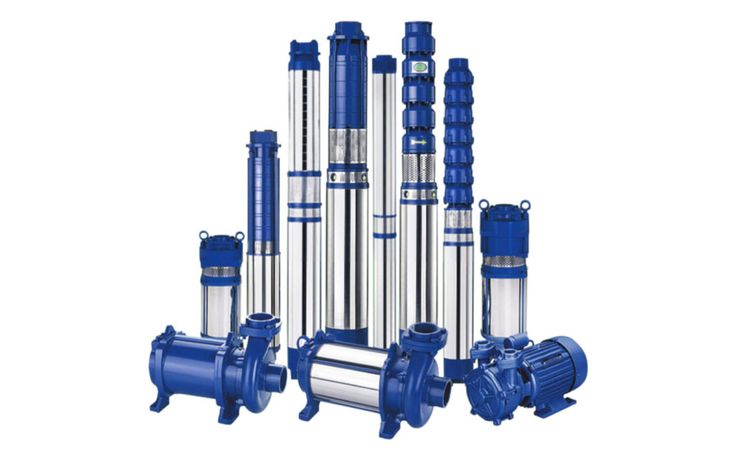
Sewage pumps move waste from places gravity cannot reach: basements, low-lying plots, buildings below the sewer, and whole neighbourhoods through lift stations. They work with solids, rags, grease and corrosive gases, so they fail in ways clean-water pumps do not. This sewage and wastewater pump installation guide covers selecting the pump, designing the wet well, laying out the pipework, wiring controls and keeping the station safe and serviceable.
Design values below are common engineering guidelines. Local standards, the county water and sewerage company and the pump manufacturer take priority, and larger stations should be designed by a qualified engineer.
Types of Wastewater Pumps
Submersible non-clog pumps. The pump and motor sit together in the wet well, below liquid level. They are quiet, compact and self-priming by design, and are the most common choice for small and medium stations. They are removed for service, normally on guide rails.
Dry-pit (dry-well) pumps. The pump sits in a separate dry chamber beside the wet well, with the motor above or beside it. Easier to inspect and service, but more expensive to build, and the dry pit needs ventilation and flood protection.
Grinder pumps. Chop solids into a slurry so the waste can be pumped through small-diameter pressure pipes. Used for single houses or small groups, and low-pressure sewer systems.
Sewage ejector and sump pumps. Smaller units for buildings. Ejectors handle sewage solids, while sump pumps are for clean or lightly contaminated drainage and must not be used for toilet waste unless rated for solids.
Vortex (recessed impeller) pumps. Keep solids away from the impeller, giving good clog resistance with lower efficiency, useful for rag-prone or fibrous waste.
Choosing the Right Pump: Key Questions
- What is in the liquid? Domestic sewage, grey water, trade effluent, storm water, grit or grease? Choose a pump designed for the solids.
- What solids size must pass? Typical sewage pumps are specified to pass spheres of about 50 to 80 mm (2 to 3 inches). Fibrous rag and wipes are a larger problem than solid size.
- Flow and head: the design flow, static lift, friction losses in the rising main and minor losses give the duty point.
- Corrosion and abrasion: hydrogen sulphide and grit attack materials, so choose cast iron with coatings, stainless steel or other suitable materials.
- Motor and sealing: look for double mechanical seals with an oil chamber, with leak and temperature sensors on larger units.
- Explosion protection: in some wastewater installations and industrial duties, areas around the wet well can be classified as hazardous due to methane and hydrogen sulphide, requiring approved equipment.
- Reliability: critical stations should have at least two pumps, so one can fail without loss of service.
Sizing the Flow
For a building or small development, estimate peak flow from fixture units or from per-capita use, applying a peaking factor, because sewage flow is far from constant. For lift stations serving a catchment, designers use average daily flow and apply a peak factor, which is higher for small populations, and allow for infiltration and future growth. The pump’s rated capacity should handle the peak flow with the largest pump out of service in duplex or multi-pump stations (N+1).
Wet Well Design
The wet well stores wastewater between pump cycles, and its design strongly affects reliability.
- Volume and cycle time: the working volume between “pump on” and “pump off” levels should limit pump starts, commonly to no more than about 6 to 10 starts per hour for typical motors, giving a minimum cycle time of roughly 6 to 10 minutes. Check the motor manufacturer’s limit. Fixed-speed pumps need more storage than variable-speed pumps.
- Avoid long retention: wastewater that stays in the well too long turns septic, producing hydrogen sulphide, odours and corrosion. Many guidelines aim to keep retention to about 30 minutes or less at design flow, and especially for small flows, this is balanced against start frequency.
- Shape and floor: a sloped or benched floor directing solids to the pump inlet reduces sludge build-up. Avoid flat floors with dead corners.
- Inlet arrangement: bring the incoming sewer in below the water level or with controlled drop and baffles to limit turbulence, air entrainment and odour release. Locate the inlet so flow does not hit the pump suction directly.
- Submergence and clearances: follow the manufacturer’s and the Hydraulic Institute’s minimum submergence, floor clearance and spacing between pumps and walls to avoid vortices and air entrainment.
- Access: provide access hatches large enough for the pump to be lifted out, a lifting davit or crane, and safe access arrangements.
- Materials: concrete wells need protective linings in septic or corrosive conditions, and fibreglass or polyethylene packaged wells are common for small stations.
- Ventilation: provide vents for the wet well to release gases and let air in and out as the level changes, with odour control where needed.
- Overflow and emergency storage: consider an emergency overflow arrangement or storage, and a connection point for a mobile pump or generator, subject to local environmental rules.
Pipework and Valves
Rising main (force main):
- Choose pipe diameter so that velocity is high enough to keep solids moving, a common target being at least about 0.6 to 0.9 m/s (2 to 3 ft/s) at least once per cycle, and not so high that friction losses or surge become excessive, often no more than about 2.5 to 3 m/s.
- Typical minimum pipe size for raw sewage with solids is 100 mm (4 inches) for non-grinder pumps, to reduce blockage risk.
- Use pipe materials suitable for pressure and corrosion, such as ductile iron, HDPE or PVC, and protect against hydrogen sulphide where relevant.
- Provide air release valves at high points, and consider cleanouts or pigging points on long mains.
- Evaluate surge (water hammer) in long or high-head mains.
Valves:
- Install a non-return (check) valve on each pump discharge, preferably a swing check with an external lever and weight, or a ball check suited to sewage. Avoid valves that foul easily with rags.
- Install an isolation valve (gate or knife gate) after the check valve, so that the pump can be removed while the others run.
- Locate valves in a separate valve chamber accessible without entering the wet well, if possible.
- Provide a bypass or emergency pumping connection for contingencies.
Guide rails and coupling: for submersible pumps, a guide rail and discharge elbow system lets the pump be lowered into place and sealed against the discharge without anyone entering the well.
Electrical and Controls
- Level control: float switches, ultrasonic or pressure level sensors determine pump start, stop and alarm levels. Floats must hang free of cables and pipes. Typical levels, from low to high, are: pump-off, lead pump on, lag pump on, and high-level alarm.
- Duplex alternation: the control panel alternates lead and lag pumps to equalise wear, and starts the second pump if the level continues to rise or if the first fails.
- Motor protection: overload, phase failure, under-voltage, thermal sensors in the winding, seal-leak sensors and, for submersibles, protection against running dry.
- Alarm and telemetry: a high-level alarm with a light and sounder, and remote alerts to a phone or control room by GSM or SCADA, because failures at unattended stations cause overflows.
- Panel location: mount control panels outside the wet well and away from corrosive gases, with suitable ingress protection, in a ventilated, flood-safe position. If hazardous gas is possible, use appropriate barriers and sealing so gas cannot travel through the cable into the panel.
- Standby power: consider a generator or a connection for a mobile generator for critical stations, and surge protection for lightning-prone areas.
- Variable frequency drives: can maintain a minimum self-cleansing velocity and reduce starts. Follow the manufacturer’s guidance for cable, filters and minimum speed.
Installation Steps
- Prepare the site: confirm levels, inlet and outlet invert, services and groundwater. Dewater the excavation if required.
- Install the wet well: set it level on a prepared base, with anti-flotation measures (such as a concrete collar or ballast) if the groundwater table is high, since empty wells can float.
- Connect the inlet and the rising main with correct falls, supports and joints, testing the pipework to the specified pressure.
- Fit guide rails, discharge elbows and lifting chains according to the manufacturer’s instructions.
- Install pumps and connect cables through sealed glands, leaving cable slack and securing it so it cannot be drawn into the pump or floats.
- Install level sensors at the specified heights.
- Install the control panel and make all electrical connections to code, with correct earthing.
- Fill the well with clean water and test: check rotation, current, flow, pressure, alternation, alarms and the operation of the check valves.
- Commission with real flow and monitor for vibration, noise and air locks. Vent the pump casing if air lock occurs.
- Document the installation: as-built drawings, pump curves, settings, test results and an operation and maintenance manual.
Safety: Wastewater Stations Are Hazardous
Wet wells and sumps are confined spaces and can contain toxic and explosive gases (hydrogen sulphide, methane), low oxygen, and biological hazards.
- Never enter a wet well without a permit system, gas testing, ventilation, a standby person and rescue equipment.
- Design for service without entry, using guide rails, lifting equipment and valves outside the well.
- Wear protective equipment and maintain good hygiene, with vaccinations and washing facilities for staff who handle wastewater.
- Use warning signs and lockable covers, with fall protection at openings.
Maintenance
- Weekly to monthly inspection: check alarms, levels, run times and starts per day, listen for noise and check for vibration. Unusual run-time changes can reveal clogging or wear.
- Clean the wet well at regular intervals to remove grease, grit and sludge, and clear floats and sensors.
- Inspect pumps for rag build-up, impeller wear, clearance and seals, according to the manufacturer’s schedule, and carry out insulation resistance tests on the motor.
- Test the check and isolation valves, and exercise standby pumps.
- Test the telemetry and alarms, and the standby generator, if fitted.
- Keep spares: a spare pump or critical parts, seals, floats and fuses.
- Keep records: run hours, current, faults and repairs, so trends are visible.
Common Problems and Fixes
| Problem | Likely cause | Fix |
|---|---|---|
| Pump clogs repeatedly | Rags and wipes, wrong impeller | Use vortex or cutter pumps, install a screen or grinder, educate users |
| Frequent starts | Wet well too small, floats too close | Increase the working volume or adjust levels, consider a VFD |
| Odour and corrosion | Septic wastewater, long retention | Shorten retention, ventilate, add odour control, line the well |
| Pump runs but little flow | Air lock, blocked check valve, worn impeller | Vent the pump, clear valve, inspect impeller |
| Motor trips | Overload, blockage, phase fault | Clear blockage, check the supply and protection settings |
| Overflows at high flows | Under-capacity, power failure | Re-assess capacity, add a standby pump and standby power |
Conclusion
A reliable sewage and wastewater pump installation depends on matching a non-clog pump to the waste, designing a wet well that limits starts and septicity, laying out the rising main with enough velocity and the right valves, and providing robust controls, alarms and standby arrangements. Plan for safe service without entry and for regular cleaning and maintenance, because wastewater stations fail when they are forgotten. Confirm design criteria with local standards and the pump manufacturer.
Sources and Further Reading
- Hydraulic Institute, ANSI/HI 9.8, pump intake design: pumps.org
- Design standards and guidance for wastewater lift stations published by municipal and state authorities, for example the City of Durham, “Lift Station Design Standards” (2024): durhamnc.gov
- Environmental Finance Center Network, “Lift Station Operation and Maintenance” webinar materials: efcnetwork.org
- Ten States Standards (Recommended Standards for Wastewater Facilities): tenstates.org
- Kenya Water Services Regulatory Board (WASREB) and county water and sewerage companies: wasreb.go.ke
