
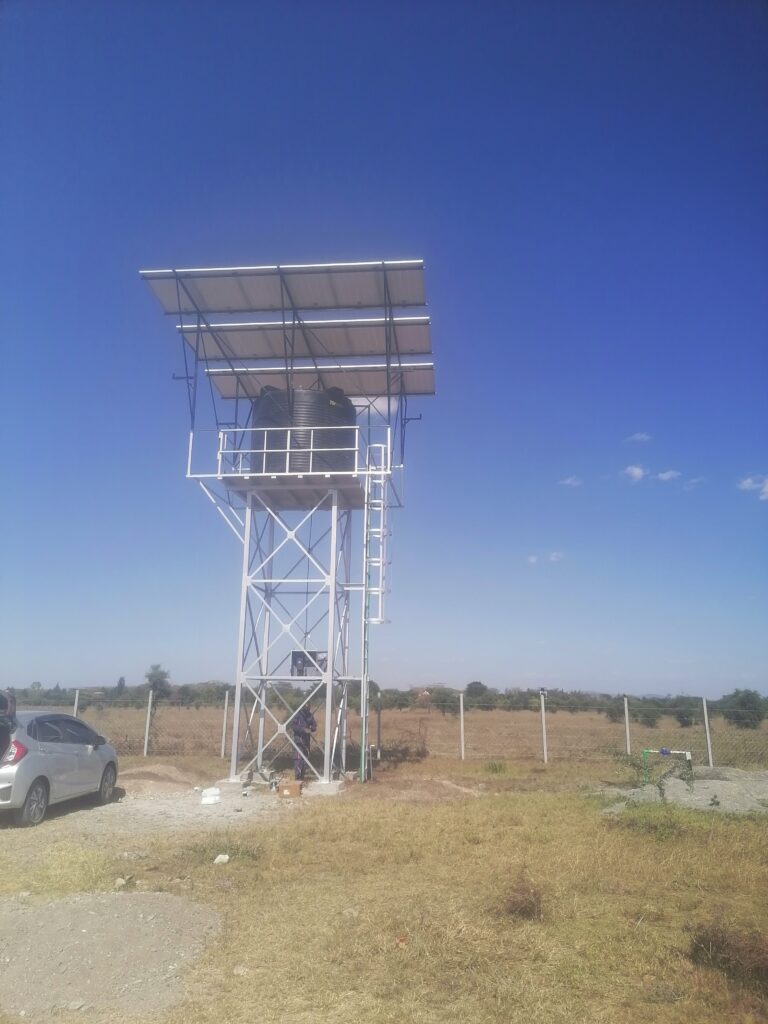
The tower gets the attention, but the tank is what stores the water, and its type decides weight, cost, water quality, lifespan and how the tower must be designed. This article explains the main tank types used on steel water towers, how storage volume and height are sized, and the structural and hydraulic basics every designer should understand.
Sizing the Storage
Storage volume depends on demand, supply reliability and purpose.
- Daily demand. Estimate population or users and a per-person consumption. Rural supplies often use 20 to 50 litres per person per day; towns and institutions may use 80 to 150 litres or more.
- Storage ratio. A common design is to store 25 to 50 percent of daily demand for balancing peaks, or a full day’s demand where supply is unreliable.
- Fire and emergency reserve, where required.
- Solar pumping buffer. With solar pumps, the tank should store enough for cloudy days and night use, often one day’s demand or more.
For example, a school of 600 pupils using 15 litres each per day needs about 9 m³ per day, so a 10 to 20 m³ tank gives one to two days of storage.
Sizing the Height
The required height depends on the pressure needed at the furthest and highest tap. As a rule, 1 m of elevation gives about 0.1 bar. If the minimum service pressure is 1 bar at the end of the network, and friction losses and ground elevation differences consume 0.5 bar, the tank base must be about 15 m above the lowest outlet. Hydraulic modelling of the network confirms the exact value. Over-height raises cost and wind load; under-height gives weak pressure.
Common Tank Types
Pressed steel sectional (bolted) tanks
Square panels, typically 1 m × 1 m or 1.22 m × 1.22 m, bolted together with sealing strips. Panels are hot-dip galvanized or coated with epoxy.
- Best for: remote areas, volumes from 5 m³ to several hundred m³.
- Advantages: easy transport, expandable, quick assembly, no welding on site.
- Limits: many joints that can leak if poorly sealed; water chemistry affects galvanized finishes.
Welded steel cylindrical tanks
Steel plates are rolled and welded, with a flat or conical bottom and domed or conical roof.
- Best for: larger volumes and municipal supplies, built to AWWA D100 or EN 14015.
- Advantages: leak-tight, long life with correct coating.
- Limits: needs skilled welders, inspection and heavier transport.
Glass-fused-to-steel and factory-coated bolted tanks
Panels are coated at the factory with glass or epoxy, then bolted on site, as in AWWA D103.
- Advantages: excellent corrosion resistance and water quality.
- Limits: higher initial cost, careful handling required to avoid damaging the coating.
Polyethylene (plastic) tanks on steel stands
Moulded tanks, usually up to about 20 m³ and mounted on a steel platform.
- Advantages: low cost, no internal corrosion, light weight.
- Limits: sensitive to UV unless pigmented, needs full-base support, limited size and lifespan.
Stainless steel tanks
Panel or welded construction in grade 304 or 316.
- Advantages: durable and hygienic.
- Limits: expensive, and chloride attack can still occur in poor-quality grades.
Composite or multi-column elevated tanks
Large steel tanks supported by tubular columns or a concrete shaft, used for municipal storage.
Tank Shapes
- Rectangular tanks use space efficiently and suit sectional panels, but need internal ties or heavy plates to resist pressure.
- Cylindrical tanks resist hydrostatic pressure efficiently through hoop tension.
- Spherical and conical-bottom tanks are used for very specific designs and larger towers.
Hydrostatic Pressure and Tank Wall Design
Water pressure at depth h is p = ρ g h, or about 9.81 kPa per metre depth. At the bottom of a 3 m deep tank the wall pressure is about 29 kPa. Wall plates must resist this pressure with thickness, stiffeners or tie rods. Cylindrical walls carry it as hoop tension, T = p × r. Rectangular walls bend, so they need stiffening and ties. Designers use AWWA D100, AWWA D103 or EN 1993-4-2 for plate thickness, stiffeners and weld or bolt checks.
Loads Transferred to the Tower
- Vertical weight: water plus tank steel. Roughly 1 tonne per m³.
- Wind on the tank and roof: acts high above ground.
- Seismic loads and sloshing: water movement adds forces during earthquakes.
- Piping and equipment loads: pipes, ladder, solar panels and platform.
The tank sits on a support grillage designed to spread load evenly into the tower legs. The tank base must be supported uniformly; point loads can distort the floor.
Water Quality Design Features
- Opaque or light-proof material prevents algae growth.
- Sloping floor and drain allow sediment removal.
- Sealed roof with screened vent and lockable manhole protects against contamination.
- Smooth, approved interior surfaces, with coatings certified for drinking water.
- Inlet and outlet positions designed to avoid dead zones and stagnant water.
- Insulation or reflective paint reduces warming in hot climates.
Material Choices and Life Expectancy
| Tank type | Typical design life |
|---|---|
| Galvanized sectional | 20 to 30 years with maintenance |
| Epoxy or glass-lined bolted | 30 to 40+ years |
| Welded steel, well coated | 40+ years |
| Polyethylene | 15 to 25 years |
| Stainless steel | 40+ years |
Water chemistry strongly influences life, especially low-hardness, acidic or high-chloride water, which attacks zinc.
Design Checklist for Tank Selection
- Required volume and growth allowance.
- Required height and pressure.
- Water chemistry and corrosion risk.
- Site conditions, access and transport limits.
- Budget and lifecycle cost.
- Standards and local approvals.
- Future expansion or solar integration.
Conclusion
Selecting the right tank means balancing volume, pressure, water quality, durability and cost. Pressed steel sectional tanks dominate rural projects, welded and coated tanks suit larger schemes, and plastic tanks fit small installations. Whatever the type, size it correctly, support it properly and design the tower around the true loads.
Key references: AWWA D100; AWWA D103; EN 1993-4-2; EN 14015; NSF/ANSI 61.
