
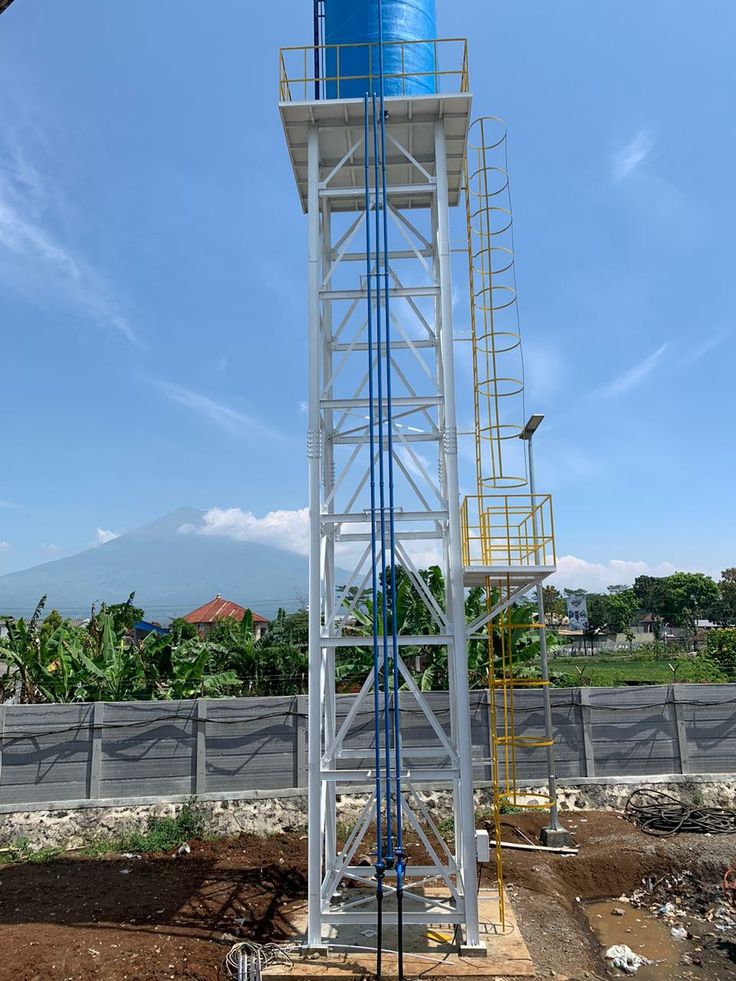
A water tower looks like a tank on a stand, but it is a system of structural, hydraulic, electrical and safety parts that must work together. If one fails, the others suffer: a clogged vent can collapse a tank, a stuck float valve can flood the foundation and a missing earth rod can leave a solar pump unprotected from lightning. This article walks through the main components of a steel water tower and explains what each one does.
The Foundation
The foundation carries the full weight of the tower, tank and water into the ground and resists uplift when the tank is empty and wind is strong. Typical forms are pad-and-chimney footings under each leg, a raft slab or piles. Anchor bolts cast into the concrete connect the tower legs to the foundation, and their position must be accurate to a few millimetres.
The Tower Structure
- Legs carry the main vertical and overturning forces.
- Horizontal struts and diagonal bracing keep legs in position and resist wind shear.
- Base plates distribute leg loads into the concrete.
- Top platform or support grillage, a steel frame of beams that spreads the tank load into the legs.
- Bolted joints connect members, so the tower can be shipped in pieces and assembled on site.
Monopole towers replace the legs and bracing with a single tubular column and a top flange or cone.
The Storage Tank
The tank stores the water. Its shape, material and coating affect cost and water quality.
- Pressed steel sectional tanks use bolted panels with sealant between joints. Internal tie rods or external stiffeners resist water pressure.
- Welded steel tanks have continuous welds and are lined or coated internally.
- Roof keeps out dust, insects, rain and light. Light promotes algae growth, so tanks should be opaque.
- Floor often slopes slightly towards a drain or sump for cleaning.
- Internal lining or galvanizing protects steel from corrosion without contaminating water.
Pipework and Hydraulic Fittings
Inlet pipe. Brings water from the pump or main supply. Often fitted with a float valve or solenoid valve to stop filling when the tank is full.
Outlet pipe. Takes water to the distribution network. It should be raised slightly above the floor so sediment does not enter the supply, and have a strainer where needed.
Riser or down pipe. Runs from the tank to the ground, often inside or beside the tower. It should be supported on brackets that allow for expansion.
Overflow pipe. Protects the tank from overfilling. It must be large enough to carry the maximum inflow, discharge away from foundations and end with a screened outlet to keep out animals.
Drain or washout pipe. Empties the tank for cleaning and repairs.
Isolation and bypass valves. Allow the tank to be taken out of service without interrupting supply.
Air vent. Lets air in as water leaves and out as water enters. A blocked vent can cause vacuum collapse or burst the roof. It must be screened against insects and birds.
Level Control and Monitoring
- Float valves open and close mechanically.
- Level switches at high and low points switch the pump on and off.
- Ultrasonic or pressure sensors provide continuous level readings, which can be shown on a display or sent remotely.
- Alarms warn of low water, overflow or pump failure.
Automatic control saves energy and prevents wasted water.
Access and Safety Features
- Ladder from the ground to the platform, with a fall-arrest cable or rail.
- Cage or fall-arrest system as required by safety standards.
- Platform and handrails around the tank for safe work.
- Roof manhole with a lockable lid, for inspection and cleaning.
- Anti-climb guard at the base ladder to deter unauthorised access.
- Warning signs.
Solar Power Components
Many water towers now supply energy as well as storage.
- Solar panels mounted on a frame at the top platform, on the tower side or on a separate ground structure, power the borehole pump or booster pump.
- Mounting frame holds panels at the correct tilt and resists wind uplift.
- Controller or variable-speed drive adjusts pump speed to match sunshine.
- Cabling and isolators link panels to the controller and pump, with weather-proof conduits.
- Batteries are sometimes added for night pumping but are often unnecessary because the tank itself acts as energy storage.
- Pump lifts water from the borehole or source to the tank.
Placing panels so that the tank and tower do not shade them is part of good design.
Earthing and Lightning Protection
A tower is the tallest object on the site, so it attracts lightning. A proper system includes an air terminal at the top, a down conductor or bonded steel path, an earth electrode system at the base and surge protection devices on the pump controller and solar cables. Kenya has high lightning density in many areas, so this is not optional.
Obstruction Lighting and Marking
Taller towers, or those near airstrips, may need aviation lights or painted bands. This is more common for towers above about 45 m or sites near airports, and KCAA guidance should be checked.
Coatings and Corrosion Protection
The tower is normally hot-dip galvanized, sometimes with an added paint system. The tank interior is galvanized or lined with a potable-water-approved coating. The exterior may be painted in light colours that reflect heat and reduce water warming.
How the System Works Together
During sunshine, the solar pump lifts water from the borehole through the inlet pipe into the tank. When the level sensor reaches the high mark, the pump stops. Water flows by gravity from the outlet pipe into the distribution network, with pressure set by the height of the tank. As the level drops to the low mark, the pump starts again. The overflow protects against control failure, the vent equalises pressure, the earthing system protects the electronics and the tower structure holds everything safely above ground.
Maintenance Points
- Clean and inspect the tank at least once a year.
- Check float valves, level sensors and vents regularly.
- Inspect bolts, coatings and base plates.
- Test earthing and surge protection.
- Clean solar panels and check cables.
- Keep the area around the tower clear and drained.
Conclusion
Each component of a steel water tower has a clear job. Knowing what the parts do helps owners and operators spot problems early, ask better questions of contractors and keep water flowing safely. When upgrading or adding solar equipment, always have a qualified engineer check that the tower can carry the extra load.
Key references: AWWA D100; AWWA D103; AWWA M42; EN 1993-4-2; IEC 62305.
