
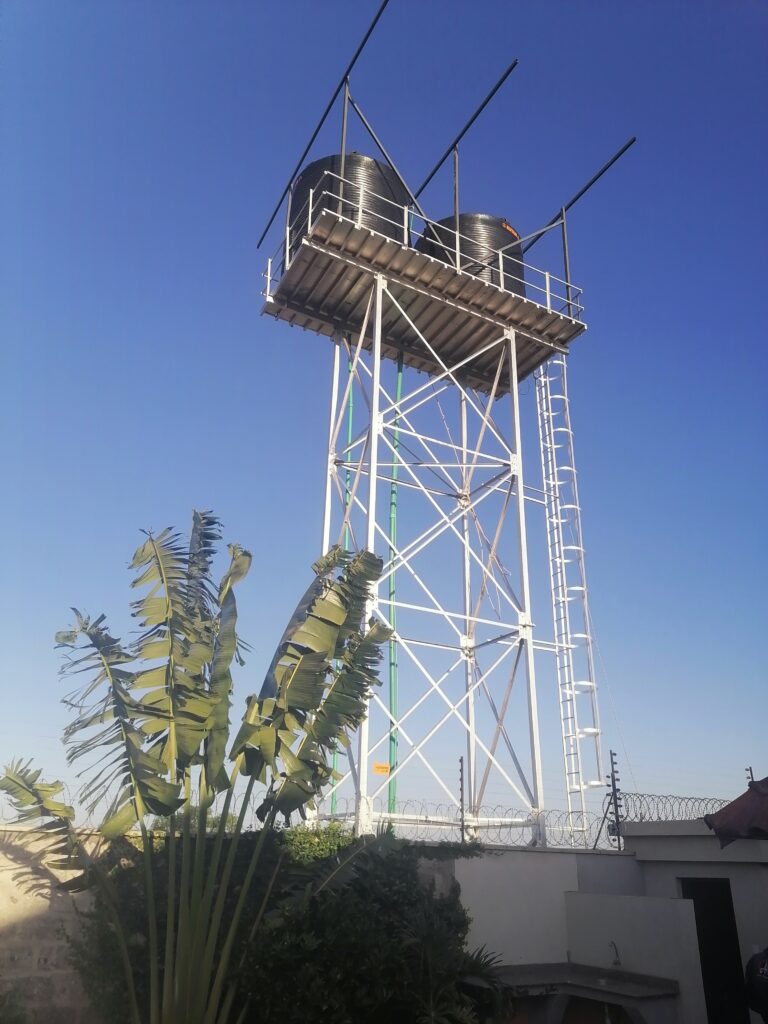
Choosing the wrong tower type is one of the costliest early mistakes in a communications or utility project. Lattice, monopole and guyed towers all hold equipment in the air, but they differ widely in footprint, cost, appearance, height capability and maintenance needs. This article compares the three, explains where each performs best, and gives a practical way to decide.
Lattice Towers: The Efficient Workhorse
A lattice tower, also called a self-supporting tower, is a braced framework with three or four legs connected by diagonal and horizontal members. Legs are made from steel angles, solid round bars or tubes. Because loads are carried as axial tension and compression in slender members, the structure uses material very efficiently.
Advantages
- Excellent strength and stiffness for the weight of steel used.
- Low wind area per metre compared with a solid shaft of similar capacity.
- Can reach 100 m or more without guy wires.
- Suitable for heavy antenna loads, microwave dishes and future expansion.
- Easy to transport, since members are small, and easy to assemble in remote areas.
- Simple to modify by adding or replacing members.
Limitations
- Larger footprint, particularly at the base, where leg spacing can be several metres.
- More bolts and members to inspect and maintain.
- Visually prominent, which can raise objections in residential areas.
- Longer erection time than a monopole.
Best uses: rural and peri-urban telecom sites, microwave backbone routes, broadcasting, heights above 30 m, heavy loading and locations with limited crane access.
Monopoles: Small Footprint, Clean Look
A monopole is a single tapered tubular shaft built in sections that slip-fit or flange together. Cross-sections may be round, 12-sided, 16-sided or 18-sided. Foundations are usually a single large concrete pier or pile.
Advantages
- Very small land take, often just a few square metres.
- Neat appearance; easier to obtain planning permission in urban areas.
- Fast erection, sometimes in a single day with a crane.
- Few bolts and fewer places for corrosion to start.
- Easy to disguise as a tree, flagpole or streetlight.
Limitations
- Less efficient per tonne of steel above about 40 m, so cost climbs steeply with height.
- More flexible, so antenna alignment can suffer under strong wind.
- Heavy sections require cranes and larger transport vehicles.
- Upgrades are harder because internal space is limited and the shaft is a single load path.
Best uses: urban and suburban sites, rooftop-adjacent locations, road corridors, locations with strict height or appearance rules, and heights up to roughly 35 to 45 m.
Guyed Masts: Maximum Height at Minimum Steel
A guyed mast is a slender lattice or tubular mast held upright by steel cables anchored in the ground at several levels. The mast mainly carries vertical load while the guys resist the overturning wind forces.
Advantages
- The lowest steel weight per metre of height; economic above 60 m.
- Practical for very tall structures: broadcast masts exceeding 200 m are common worldwide.
- Smaller foundations at the mast base.
Limitations
- Needs a large land area, generally a radius of 60 to 80 percent of the mast height.
- Guy wires need regular tension checks and corrosion monitoring.
- Vulnerable to vandalism and theft of anchor components.
- Failure of one guy can influence the whole mast.
- Not suited to urban or tight sites.
Best uses: radio and TV broadcasting, long-range communication, meteorological masts and remote open areas where land is cheap.
Side-by-Side Comparison
| Factor | Lattice | Monopole | Guyed Mast |
|---|---|---|---|
| Typical height range | 20 to 120 m | 12 to 45 m | 40 to 300 m |
| Footprint | Medium | Smallest | Largest |
| Steel per metre at height | Moderate | Highest | Lowest |
| Installation speed | Moderate | Fastest | Moderate |
| Maintenance | Moderate | Low | High (guys) |
| Visual impact | High | Low | Moderate |
| Capacity for future antennas | High | Limited | Moderate to high |
Factors That Should Drive Your Decision
Height required. Below 30 m, monopoles are competitive. Between 30 and 60 m, lattice towers often win. Above 60 m, guyed masts or large lattice towers are usually the economical choices.
Available land. If the site is a small plot or rooftop, a guyed mast is impossible and a lattice tower may not fit.
Planning and appearance. Many county planning offices prefer monopoles in neighbourhoods and along roads.
Loading now and in future. Tower operators often add dishes and panel antennas over the years. A lattice tower can usually be strengthened more easily than a monopole.
Soil conditions. Poor soils may favour a lattice tower with several light footings or a guyed mast with small base loads, instead of one heavy pier. Geotechnical data should always guide this decision.
Construction access. Remote sites with poor roads suit lattice towers whose members can be carried by light trucks. Monopoles need cranes and wide transport routes.
Budget and lifecycle cost. Compare total cost: steel, galvanizing, foundations, transport, erection, land lease, and inspection. A cheaper tower on a bad site may cost more over 25 years.
Common Mistakes
- Choosing a monopole for a height where the steel cost becomes excessive.
- Selecting a guyed mast without checking land ownership for the anchors.
- Designing for current antennas only, with no allowance for growth.
- Skipping geotechnical investigation and then finding that the planned foundation cannot be built.
- Ignoring wind exposure on ridges and escarpments, where design wind speed should be increased for topography.
Conclusion
There is no universally best tower. Lattice towers deliver strength, height and growth capacity at moderate cost. Monopoles trade steel efficiency for a small footprint and a neat look. Guyed masts offer unmatched height economy where land is available. Match the structure to the site, the loading and the regulatory environment, and have a structural engineer confirm the choice against the governing standard.
Key references: ANSI/TIA-222-H; EN 1993-3-1; EN 1991-1-4.
