
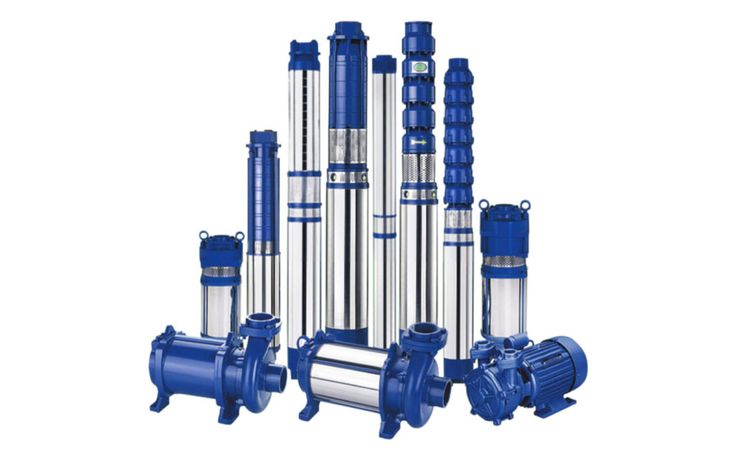
Choosing a pump from a catalogue by horsepower or by price is one of the most common and costly mistakes in water engineering. Pumps do not deliver a fixed output. Their flow, pressure, power consumption and efficiency all change depending on the system they are connected to. The right choice depends on three connected ideas: the flow rate you need, the head you must overcome, and the duty point where the pump and system actually meet.
This guide explains each concept in plain language and shows a practical selection process you can follow on real projects.
Understanding Flow Rate
Flow rate (Q) is the volume of liquid a pump delivers per unit of time. It is commonly expressed in litres per second (L/s), cubic metres per hour (m³/h), litres per minute (L/min) or US gallons per minute (GPM).
Start by determining the real demand.
Domestic and building supply. Estimate peak demand from the number of fixtures, occupants and simultaneous use. Building codes and plumbing guides provide fixture-unit methods for sizing.
Irrigation. Calculate crop water needs, irrigated area, irrigation efficiency and operating hours per day. Divide the daily volume by the pumping hours to get the required flow rate.
Livestock and farms. Add up daily needs for animals, cleaning, dairy cooling and other uses, then allow for peak periods.
Industrial and process. Use process data and design margins from the engineers responsible for the process.
Borehole supply. Match the pump flow to the sustainable yield of the borehole. Pumping above the safe yield causes drawdown, sand pumping, pump damage and possible well failure. Pumping test data should guide the selection.
Avoid inflating the number. Adding generous safety factors at every step creates oversized pumps that run inefficiently and wear faster. Use realistic peak demand with a modest margin, typically 10 percent or so unless future expansion is planned and documented.
Understanding Head
Head (H) is the energy a pump adds to the liquid, expressed as the height of a liquid column in metres or feet. It lets us compare pumps and systems without worrying about the liquid’s density. For water, 10.2 metres of head equals about 1 bar of pressure.
The head a pump must produce is called the total dynamic head (TDH). It combines:
- Static head: the vertical difference between the liquid source level and the discharge point, including any lift from below ground.
- Pressure head: any pressure required at the delivery point, such as at a sprinkler, nozzle or pressurised tank.
- Friction head: energy lost to pipe friction, valves, bends and fittings.
- Velocity head: usually small, but included in careful calculations.
TDH is the number that determines pump selection, and it increases with flow because friction rises roughly with the square of velocity. A dedicated article in this series explains the full TDH calculation, but the principle is simple: more flow through the same pipe means more head required.
The System Curve
A system curve plots the head needed by the pipework against flow rate. It has two parts:
- A static component that stays constant regardless of flow.
- A friction component that rises as flow increases.
At zero flow, the system needs only the static head. At higher flows, friction adds to the requirement, producing a rising curve. A system with long, narrow pipes has a steep curve. A system with short, large-diameter pipes has a flatter one.
The Pump Curve
Every pump has a performance curve supplied by the manufacturer. For a centrifugal pump, the main curve plots head against flow, usually falling as flow increases. Alongside it are curves for:
- Efficiency: which peaks at the best efficiency point (BEP).
- Power: the shaft power absorbed at each flow.
- NPSH required: the suction conditions the pump needs to avoid cavitation.
Reading these curves correctly is essential, and a separate article in this series walks through the process.
The Duty Point: Where Pump and System Meet
The duty point (or operating point) is where the pump curve intersects the system curve. It tells you the actual flow and head the pump will deliver in your system. This point, not the nameplate or the catalogue headline, defines performance.
If the duty point falls:
- Near BEP: the pump runs efficiently, with lower vibration, longer bearing and seal life and lower energy use.
- To the left of BEP (low flow): the pump may overheat, recirculate internally, vibrate and wear faster.
- To the right of BEP (high flow): the pump may cavitate, overload the motor and suffer impeller damage.
A good rule of thumb is to select a pump whose duty point lies within roughly 70 to 110 percent of BEP flow, ideally close to 100 percent. For systems with varying demand, check performance at both minimum and maximum flows, not just the design point.
A Practical Selection Process
Step 1: Define the liquid and conditions. Record type of liquid, temperature, density, viscosity, solids, corrosiveness and altitude.
Step 2: Establish the required flow rate. Use realistic demand, including peak and average values.
Step 3: Calculate total dynamic head. Include static lift, friction in pipes and fittings, and required delivery pressure.
Step 4: Choose the pump type. Select the type that suits the liquid, installation and duty, whether end-suction, multistage, submersible, borehole turbine or another.
Step 5: Review manufacturer curves. Find pump models whose curves pass through or near your flow and head, with BEP close to the duty point.
Step 6: Check efficiency and power. Compare efficiency across candidates. Verify that the motor has adequate margin at the duty point and across the expected operating range.
Step 7: Check suction conditions. Compare available NPSH with required NPSH, with a safety margin, particularly for surface pumps.
Step 8: Consider control. Decide whether fixed speed, variable speed or multiple pumps best suit the demand pattern.
Step 9: Check materials and construction. Confirm that casing, impeller, shaft, seals and elastomers suit the liquid and temperature.
Step 10: Compare lifecycle cost. Energy often outweighs purchase price over the pump’s life. A more efficient pump may pay for itself quickly.
A Simple Worked Example
Suppose a farm needs to pump 20 cubic metres per hour of clean water from a tank to a header tank. The static lift is 18 metres, and friction losses in the pipework and fittings at that flow are calculated as 6 metres. The delivery is to atmospheric pressure, so no extra pressure head is needed.
- Flow: 20 m³/h
- Total dynamic head: 18 + 6 = 24 metres
The designer searches pump curves for a model that delivers about 20 m³/h at 24 metres, with BEP close to that point. Suppose Pump A has BEP at 22 m³/h and 25 metres with 68 percent efficiency, and Pump B has BEP at 40 m³/h and 30 metres with 72 percent efficiency. Pump B has a higher peak efficiency, but at the duty point it would operate far to the left of BEP, where its efficiency would be much lower and reliability poorer. Pump A is the better choice because it operates near its BEP.
This illustrates why the duty point matters more than headline efficiency or horsepower.
Adjusting Pump Performance
Real systems rarely stay constant, and pumps can be adjusted in several ways.
- Throttling a valve: increases system resistance and moves the duty point left. It is simple but wastes energy.
- Variable speed drives: change pump speed, shifting the pump curve according to affinity laws. Flow changes in proportion to speed, head with the square of speed and power with the cube. Small speed reductions can produce large energy savings.
- Impeller trimming: reduces impeller diameter permanently to match a duty point more closely.
- Parallel and series operation: multiple pumps can share flow or add head, but their curves must be compatible and the combined behaviour checked carefully.
Common Selection Mistakes
- Selecting by horsepower or price without checking the curve.
- Using inaccurate head calculations, especially underestimating friction.
- Oversizing for safety, leading to inefficient operation and higher wear.
- Ignoring system variability, such as seasonal demand, changing water levels or tank filling and emptying.
- Overlooking NPSH and suction conditions.
- Forgetting the borehole yield and pumping water level when selecting a borehole pump.
- Disregarding material compatibility, especially with warm, aggressive or abrasive liquids.
- Ignoring future changes, such as system expansion, without a plan to accommodate them.
Conclusion
The right pump is not the biggest or the cheapest. It is the one whose curve meets your system curve at or near its best efficiency point, delivering the flow you need at the head your system requires. Define the duty carefully, calculate total dynamic head accurately, check pump curves and suction conditions, and compare lifecycle cost rather than purchase price alone. Do this, and your pump will use less energy, suffer less wear and serve you reliably for years.
